Well, May sucked. I'm glad it's over. I lost about $12,000, but at least it wasn't worse.
I've been looking through my hand histories to figure out how I can improve. Am I playing poorly, or should I expect to have losing months on a more regular basis than previously?
These hand histories are pretty sick. Those two hands -- my biggest pots of the month -- against Perfect Donkey represented a nearly $20,000 swing. If I had won even one of those two hands, that's a $10,000 swing. My feelings about that game haven't changed. I would play it the same way if I had to do it over again.
My next biggest loss came when someone called my all-in with a naked flush draw and hit. After that came my failed bluff into a set with AK. Then I ran two pair into a set when I was tilting, ran top pair into a set, semibluffed all-in vs. a turned flush and didn't make it on the river, pushed two pair into a turned gutshot straight and lost an all-in confrontation between my flush draw against my opponent's straight draw.
If there's any common theme, it's that bad beats perpetuated themselves by putting me into a desperate mindset. I pushed so hard to try to take down pots that I dug myself into a deeper hole.
The interesting thing to me is that there weren't many absolutes in any of these hands. Given the circumstances, my reads and the board texture, most of these plays can be justified. These losing plays weren't necessarily wrong, but some of them weren't optimal.
My biggest leak doesn't show up in the hand histories. That leak is that I often played while my judgment was impaired by tilt, alcohol or pride.
This is a game of small edges, and my advantage goes way up when I'm playing with a clear head. I'll work on that.
I feel good though. I won about $3,000 tonight, and I cheered myself up earlier by reveling in others' pain over at the Beats, Brags and Variance forum on 2+2.
Up next: Vegas baby!
Friday, June 01, 2007


Monday, May 28, 2007
Confusion over Variance
Variance as it relates to poker is difficult to understand, both because the element of luck is hard to quantify and the mathematical function for variance doesn't provide many answers.
What does variance mean exactly?
In my mind, the term variance is used in poker to describe the amount of luck in any given game -- not the amount of swings. So when you say a game is high variance, that means the game's results are more likely to be determined by the cards that are dealt than by players' decisions.
Here are some definitions of variance:
1. Variance is the statistical measure of dispersion, or just how widely your results will be distributed. When variance is high enough, a small advantage may be of no use during your lifetime. When variance is low enough, a small sample will be much more likely to reflect your real advantage (or disadvantage). In other words, variance describes just how long the long haul is. In poker terms, high variance means that a small number of hands will not be very representative of your long-term expectation.
--Seriouspoker.com
2. The distribution of your results over a a set of hands or sessions, or the swings in a positive or negative direction of cash flow.
--Mike Caro University.
3. If operatorname{E}(X)"> is the expected value (mean) of the random variable X, then the variance is
 This definition and equation is meaningless to me, but I like weird-looking variables.
--Wikipedia
As a poker player, I want to know which games maximize my skill edge over my opposition.
I asked the question, "what type of game has 'more' variance between no limit, limit and tournament hold 'em?" in the 2+2 Beginners forum. The responses to that thread, Variance: NL vs. Limit vs. MTT, back up my beliefs.
I only got three responses, but they were in agreement. Multi-table tournament hold 'em seems to have the highest variance, followed by limit hold 'em and no limit hold 'em.
While no limit seems to be "high variance" because you may have to put your entire stack at risk at any time, in reality the ups and downs aren't too extreme. No limit provides the best opportunity to get the most money in with the best odds. It's the game that will separate a fish from his money the quickest. It has fewer suckouts than limit or MTTs.
For a closer look at how to attempt a poker calculation of your variance, I found this article titled, "How much bankroll do you need?" in a search.
I also enjoyed a Mike Caro article published in Bluff magazine a few months ago, in which he argued that your luck may not even out in the long run, contrary to popular belief. Check it out here: "The importance of luck in poker."
What does variance mean exactly?
In my mind, the term variance is used in poker to describe the amount of luck in any given game -- not the amount of swings. So when you say a game is high variance, that means the game's results are more likely to be determined by the cards that are dealt than by players' decisions.
Here are some definitions of variance:
1. Variance is the statistical measure of dispersion, or just how widely your results will be distributed. When variance is high enough, a small advantage may be of no use during your lifetime. When variance is low enough, a small sample will be much more likely to reflect your real advantage (or disadvantage). In other words, variance describes just how long the long haul is. In poker terms, high variance means that a small number of hands will not be very representative of your long-term expectation.
--Seriouspoker.com
2. The distribution of your results over a a set of hands or sessions, or the swings in a positive or negative direction of cash flow.
--Mike Caro University.
3. If
operatorname{E}(X)"> is the expected value (mean) of the random variable X, then the variance is This definition and equation is meaningless to me, but I like weird-looking variables.--Wikipedia
As a poker player, I want to know which games maximize my skill edge over my opposition.
I asked the question, "what type of game has 'more' variance between no limit, limit and tournament hold 'em?" in the 2+2 Beginners forum. The responses to that thread, Variance: NL vs. Limit vs. MTT, back up my beliefs.
I only got three responses, but they were in agreement. Multi-table tournament hold 'em seems to have the highest variance, followed by limit hold 'em and no limit hold 'em.
While no limit seems to be "high variance" because you may have to put your entire stack at risk at any time, in reality the ups and downs aren't too extreme. No limit provides the best opportunity to get the most money in with the best odds. It's the game that will separate a fish from his money the quickest. It has fewer suckouts than limit or MTTs.
For a closer look at how to attempt a poker calculation of your variance, I found this article titled, "How much bankroll do you need?" in a search.
I also enjoyed a Mike Caro article published in Bluff magazine a few months ago, in which he argued that your luck may not even out in the long run, contrary to popular belief. Check it out here: "The importance of luck in poker."
Saturday, May 26, 2007
The Perfect Donkey
After a long road of busting fish, taking small edges and building bankroll, you hope for that golden opportunity in which you'll be able to make a big score.
I stumbled upon that chance at a 10/20 table last night. I can't imagine there was more dead money at any other online table at the time. And it all came from one player, who I will call the Perfect Donkey. I got a seat directly to his left.
Perfect Donkey was loose (55 percent VP$IP), and he spewed chips at every opportunity and in a predictable manner. If he raised preflop and was reraised, he would go all in. If he bet out postflop and was raised, he would go all in with any Ace-high, pair or drawing hand. With made hands, he would minraise.
By sheer luck, he was building a monster stack. In 255 hands, I saw Perfect Donkey win a more than $5,000 pot with King-high, no draw against another player's flush draw with overcards. He got in with a flush draw on the turn and hit on the river against KK. He pushed with A6o on a 579 flop and hit his gutshot on the turn against JJ. He pushed an open-ended straight draw on the flop against QQ and hit on the turn.
I knew I would have a chance soon to pick a spot in a large pot.
It's funny -- after learning and playing day after day, the situation that I've been waiting for is to the left of an idiot with money. Everyone else at the table is a shark, but they didn't even bother to play against each other most of the time as they salivated over the thought of getting it in against Perfect Donkey. If Perfect Donkey wasn't in a hand, no one was.
Against this guy, I would happily take a potential coinflip because I could also have him completely dominated.
So when I was dealt AK, I reraised Perfect Donkey's $80 bet to $240, knowing he would push and I would call.
That's exactly what happened. He turned over KQ, missed a Queen, and I had doubled up!
Now with my double-sized stack, I would have a chance to make some serious money off Perfect Donkey, who somehow kept growing his chips upwards of $10,000 -- five times his initial buy-in of $2,000.
I didn't have to wait long.
I raised from under the gun with A9s. Perfect Donkey called in the big blind. The flop came a beautiful 8d, 9c, 5d to give me top pair with a nut flush draw. My only goal was to get all my money in the middle as soon as possible, and I knew it wouldn't be hard against this guy.
He bet out $60, and I raised him all in to $4,100. He called and turned over J8o for second pair, no draw.
Only a few hands later, Perfect Donkey minraised to $40, and I cold called from the button with KQ. The flop was nice, if a little dangerous: Ts, 7h, Kh. My top pair, middle kicker, no-draw hand was probably good here.
Perfect Donkey bet out $100, I raised to $300, he pushed and I called. He turned over Ah 5d, failed to improve, and I was back in business.
I chipped up to over $5,000 with the hopes of one more strong hand against this guy. One more hand to win the biggest pot of my life. One more hand to erase this month's losses. One more hand to make everything right, put a bad player in his place and feel good until I sit down at the World Series of Poker in less than two weeks.
Perfect Donkey raised to $80, and I found AK again. I know how to play this hand against this guy. I re-raised to $300, and he went all in for his entire $11,000 stack.
Did I have a decision to make here? Was there any doubt about calling another $4,700 and taking a potential coinflip?
No, there was no question. I know full well what this guy is capable of. If I fold a premium hand like AK preflop against Perfect Donkey, I might as well put my bankroll in low-risk bonds and never take another chance again in my life.
This is what I had been waiting for. I knew what I had to do. I called.
I got my coinflip. Perfect Donkey had JJ, I failed to improve, and I had lost my biggest pot. So be it.
I rebought a third time, prepared to stay up all night if that's what it took to bust this guy. But it was no use. He quit shortly afterward, leaving the table with more than $20,000. I went on to a 5/10 table where I made top set of Aces and got it all in on the turn, but an 8 on the river gave my opponent his one-outer for quads. Flopped set over set no good.
Time to rebuild. Time to grind it out. Time to get ready for the next Perfect Donkey, in hopes that I can take those same bets for thousands of dollars but perhaps with different outcomes.
I stumbled upon that chance at a 10/20 table last night. I can't imagine there was more dead money at any other online table at the time. And it all came from one player, who I will call the Perfect Donkey. I got a seat directly to his left.
Perfect Donkey was loose (55 percent VP$IP), and he spewed chips at every opportunity and in a predictable manner. If he raised preflop and was reraised, he would go all in. If he bet out postflop and was raised, he would go all in with any Ace-high, pair or drawing hand. With made hands, he would minraise.
By sheer luck, he was building a monster stack. In 255 hands, I saw Perfect Donkey win a more than $5,000 pot with King-high, no draw against another player's flush draw with overcards. He got in with a flush draw on the turn and hit on the river against KK. He pushed with A6o on a 579 flop and hit his gutshot on the turn against JJ. He pushed an open-ended straight draw on the flop against QQ and hit on the turn.
I knew I would have a chance soon to pick a spot in a large pot.
It's funny -- after learning and playing day after day, the situation that I've been waiting for is to the left of an idiot with money. Everyone else at the table is a shark, but they didn't even bother to play against each other most of the time as they salivated over the thought of getting it in against Perfect Donkey. If Perfect Donkey wasn't in a hand, no one was.
Against this guy, I would happily take a potential coinflip because I could also have him completely dominated.
So when I was dealt AK, I reraised Perfect Donkey's $80 bet to $240, knowing he would push and I would call.
That's exactly what happened. He turned over KQ, missed a Queen, and I had doubled up!
Now with my double-sized stack, I would have a chance to make some serious money off Perfect Donkey, who somehow kept growing his chips upwards of $10,000 -- five times his initial buy-in of $2,000.
I didn't have to wait long.
I raised from under the gun with A9s. Perfect Donkey called in the big blind. The flop came a beautiful 8d, 9c, 5d to give me top pair with a nut flush draw. My only goal was to get all my money in the middle as soon as possible, and I knew it wouldn't be hard against this guy.
He bet out $60, and I raised him all in to $4,100. He called and turned over J8o for second pair, no draw.
http://twodimes.net/h/?z=2725493The Jack on the river cost me that $8,500 pot when he made two pair. Damn! I would have to rebuy and start over.
pokenum -h ad 9d - 8h jd -- 8d 9c 5d
Holdem Hi: 990 enumerated boards containing 9c 8d 5d
cards win %win lose %lose tie %tie EV
Ad 9d 812 82.02 169 17.07 9 0.91 0.825
Jd 8h 169 17.07 812 82.02 9 0.91 0.175
Only a few hands later, Perfect Donkey minraised to $40, and I cold called from the button with KQ. The flop was nice, if a little dangerous: Ts, 7h, Kh. My top pair, middle kicker, no-draw hand was probably good here.
Perfect Donkey bet out $100, I raised to $300, he pushed and I called. He turned over Ah 5d, failed to improve, and I was back in business.
I chipped up to over $5,000 with the hopes of one more strong hand against this guy. One more hand to win the biggest pot of my life. One more hand to erase this month's losses. One more hand to make everything right, put a bad player in his place and feel good until I sit down at the World Series of Poker in less than two weeks.
Perfect Donkey raised to $80, and I found AK again. I know how to play this hand against this guy. I re-raised to $300, and he went all in for his entire $11,000 stack.
Did I have a decision to make here? Was there any doubt about calling another $4,700 and taking a potential coinflip?
No, there was no question. I know full well what this guy is capable of. If I fold a premium hand like AK preflop against Perfect Donkey, I might as well put my bankroll in low-risk bonds and never take another chance again in my life.
This is what I had been waiting for. I knew what I had to do. I called.
I got my coinflip. Perfect Donkey had JJ, I failed to improve, and I had lost my biggest pot. So be it.
I rebought a third time, prepared to stay up all night if that's what it took to bust this guy. But it was no use. He quit shortly afterward, leaving the table with more than $20,000. I went on to a 5/10 table where I made top set of Aces and got it all in on the turn, but an 8 on the river gave my opponent his one-outer for quads. Flopped set over set no good.
Time to rebuild. Time to grind it out. Time to get ready for the next Perfect Donkey, in hopes that I can take those same bets for thousands of dollars but perhaps with different outcomes.
Thursday, May 24, 2007
Squeeze play river bluff
One of the things I've quickly noticed at 5/10 NL and above is that the squeeze play becomes a common and important move. It isn't just for tournaments anymore.
I've always sucked at running the squeeze play, mostly because I prefer to bluff postflop. But I've learned that I can't ignore it anymore, and it can be very profitable.
I like to run the squeeze play from the big blind against a button steal raise and a cold call by the small blinds. There are many other situations when you can put in that third raise as a bluff when trying to trap dead money in the middle, but this one is pretty efficient. The button's hand range is pretty wide, and the small blind is likely to fold against a big re-raise. They both usually conclude that you have a monster.
The squeeze worked well against the small blind in the following hand. He was a loose-passive calling station, and I wasn't sure that I would be able to move him off any hand that had at least one pair. But a "value bet" river bluff won the pot for me when the small blind timed out before folding.
Fish posts small blind $5
Hero posts big blind $10
*** Dealing down cards ***
Dealt to Hero [ Ts Js ] (JTs is a decent enough hand. I would also attempt this move with many weaker hands as well)
Button raises $35
Fish calls $30
Hero raises $140 (I raise, you should fold!)
Button folds. (Thanks for folding)
Fish calls $115 (You were supposed to fold too)
*** Dealing Flop *** [ 4d, 7c, 9c ]
Fish checks.
Hero bets $250 (A continuation bet is essential after showing such strength preflop)
Fish calls $250 (Dammit. I don't know if I can get this guy off his hand. He could have anything, from overcards to a pocket pair to a flush draw)
*** Dealing Turn *** [ 3h ]
Fish checks.
Hero checks. (I think about pushing all in with my last $600, but I worry he would call with almost any draw and any pair)
*** Dealing River *** [ 6d ]
Fish checks.
Hero bets $300 (I decided to bet half my stack in a last desperate bluff attempt. I know my opponent will call with a wide range of made hands, but he'll finally fold any busted draw)
Fish folds. (It must be my lucky day)
Hero wins $1,133
Monday, May 21, 2007
"Winning in Tough Hold 'em Games"
I don't know what it was exactly that made me think limit hold 'em would be more profitable than no limit. Part of it was the allure of make 2 BB/hr at 15/30, which I thought would be an incredible winrate. It seemed like it would be easy to win one decent pot per hour at those full-ring donkfests back in the Party Poker days, when there were plenty of tables and they all seemed loose.
When I finally got to 15/30, I got smacked. I lost 2/3 of my bankroll and spent five months rebuilding it. Shortly afterward I began focusing on no limit, but I'm glad I spent time learning limit because it made me a stronger, more analytical player.
Two of the biggest leaks in my limit game were that I couldn't figure out how to play well from the blinds, and I didn't know how to handle loose-aggressive players.
"Winning in Tough Hold 'em Games: Short handed and High-Stakes Concepts and Theory for Limit Hold 'em," by Nick "Stoxtrader" Grudzien and Geoff "Zobags" Herzog is the book that I wish I had back then.
This is easily the best limit hold 'em book I've read, better than "Small Stakes Hold 'em," "Winning Low-Limit Hold 'em" and "Hold 'em for Advanced Players." That's saying a lot.
The great thing about this book is that it's practical, and it reflects the reality of today's online limit games. It's written by experts who know what the 6-max tables are like -- often with table VP$IPs around 40 and filled with aggressive players who will see showdowns at a rate that would quickly break no limit players. And the reason the games are filled with those kinds of players is that they're not very wrong to be playing like that.
For example, according to the book:
If you're not seeing showdown near 37 percent of the time you see a flop, you're probably folding too much. If you don't 3-bet preflop from the small blind around 90 percent of the time you're going to play a hand against a steal raise, you're making a big mistake. If you fold Axo or Qxs in the big blind vs. a steal, you're giving away money.
From reading board texture to adjusting for different styles to determining when it's safe to fold for one more bet on the river, this book covers a lot of ground.
It starts out with several hand charts, PokerTracker records and equity values in the first chunk of the book. These form the reference material that the rest of the book is based on, but I didn't spend a lot of time trying to memorize any of these data.
Then the book moves on to stealing, blind defense, semibluffing, betting lines, modernized bankroll advice and hand quizzes. This is great stuff.
I like to evaluate books based on whether they make me a better player when I sit at the tables. Unlike some poker books I've read, I notice the difference in my play on many hands. I've been winning more often and stealing more pots.
Online limit has died down over the last couple of years, but the shorthanded games especially are still wild. I've seen some god-awful play at all limits. Everyone wants to be an aggressive force who can control the action and get in with the best of it. "Winning in Tough Hold 'em Games" tells you how to do it.
Sunday, May 20, 2007
A great day for poker
There will be on action aplenty Sunday, and I hope to see a lot of people playing.
There's the Big Game, hosted by MiamiDon!

And we have the FTOPS Main Event at 6 p.m. on Full Tilt. I just barely won an entry by playing in a $100+9 satellite that awarded 98 seats. I already see plenty of bloggers registered: Hoy, Fuel, Cracknaces and oossuuu754. I'm sure I missed a few more in the long list of registered players, and hopefully some more will win satellite entries. Good luck!
At the same time, Fuel and I will settle our heads-up match on PokerStars. He holds a 2-0 lead in the best of 5 series, but I'm not going to go down easy.
There's the Big Game, hosted by MiamiDon!
And we have the FTOPS Main Event at 6 p.m. on Full Tilt. I just barely won an entry by playing in a $100+9 satellite that awarded 98 seats. I already see plenty of bloggers registered: Hoy, Fuel, Cracknaces and oossuuu754. I'm sure I missed a few more in the long list of registered players, and hopefully some more will win satellite entries. Good luck!
At the same time, Fuel and I will settle our heads-up match on PokerStars. He holds a 2-0 lead in the best of 5 series, but I'm not going to go down easy.
Friday, May 18, 2007
When to Bluff
Seldom do you know exactly where you stand in a contentious hand. Most postflop decisions can be characterized as an "either/or" situation. For example:
_ Way ahead-way behind:
You have a good but not great hand, while your opponent either has a lesser hand or a powerhouse that he's slowplaying. This kind of situation could come up when you have AA on a JJ8 board -- you probably have the best hand, but you could be toast against trip Jacks.
Conventional wisdom says you should be more likely to control the pot size and try to see a showdown in these situations. Bluffing big is usually a bad idea because you won't get the trips to fold.
_ Way ahead:
If you make a hidden nut straight, the board isn't paired and there's no flush draw out there, you don't have much much to worry about.
Your only guiding principle in this situation should be to try to get as much money into the pot as possible. Whether that's by playing fast or playing slow is circumstantial.
_ Way behind:
Durr. I guess you should fold. Stone-cold bluffs can be an option depending on the board texture and your opponent, but it's often better to have a backup draw.
_ A little ahead-way behind:
This is a bad spot that I find frequently comes up on the flop with two-pair hands or ignorant draws. It can be very dangerous when you hold a hand like JT on a JTQ board with two suited cards. Unless your opponent folds immediately, a conservative (but money-saving) way of playing this kind of two-pair hand is to wait for a safe card on the turn before putting in much more money. You need to be prepared to let go if the action gets too hot.
_ A little ahead-a little behind:
These are the kinds of hands where it seems like you have the best opportunity to make a big bluff. When you have a strong combination draw, you'll be close to even money anyway, and by playing strong you can take down the pot without a showdown. Even a gutshot draw combined with a backdoor flush draw and a pair can give you enough equity to make a legitimate play at the pot.
These kinds of moves are semi-bluffs, which are the best kind because "pure" bluffs can be suicidal if you run into the wrong hand.
I'm not sure how useful this is, but it can't hurt to think about these relative hand strength possibilities when deciding how you want the hand to develop. It makes Level 2 thinking a little easier.
Wednesday, May 16, 2007
Hawaii Weather
---
EasyE left a very useful comment on my post about attempts to make PokerAce HUD work faster when multitabling on Full Tilt (edited to insert updated link):
I tested his suggestions out, and I discovered that I really like Process Tamer. It seems to do the job very well! I didn't open more than four tables at a time tonight, but PokerAce ran much smoother. I also tried adjusting explicit rules for PokerAce, and it seems like "Forced Realtime" worked better than leaving it as the default. Thanks again to easyE.
I have this same problem. With me, running PAHUD with Full Tilt was virtually unusable. But I have found the following helps greatly:- surprisingly it is much quicker when I set "Flicker Free Drawing" to on. When I have this unchecked, it seems that the screen is forever redrawing, and this takes up a lot of resources. I know it's supposed to work better with this set to off, but on my PC it is SIGNIFICANTLY faster with this set on.
- running a freeware app called "Process Tamer", which you can get at http://tinyurl.com/mdhnp . You mentioned setting priorities for applications in the Windows Task Manager. Well this app let's you set rules and additional settings so that this is automatically taken care of each time FT and PAHUD are run. I've found that my system works well when I set an explicit rule so that Full Tilt is "Forced Realtime" and Poker Tracker is "Forced Below Normal". I actually don't change the settings for PAHUD.
Running it this way makes FT, PT and PAHUD very usable.
Give these a try, you might find it helps.
---
I ran a big bluff a few days ago with AK in a 10/20 game, and I wanted to hear what some of you think.
UTG raises $55VILLAIN calls $55
MP calls $55
HERO raises $250 from LP with Ah Kd (Standard raise here. I want to get money into the pot and thin the field)
UTG folds
VILLAIN calls $195 (OK, so now I know he cold called twice preflop. I put him on a mid pocket pair)
MP folds.
** Dealing Flop ** [ Js, 7h, 2c ]
VILLAIN checks.
HERO bets $400 (Obvious continuation bet that I will make every time in this spot)
VILLAIN calls $400 (Seems consistent with my suspicion that he might have a pocket pair. Maybe 88-TT. Or even 77 for a set, but I'm willing to accept that if he hit it. I also start to think he may have a Jack, but it seems unlikely given the action)
** Dealing Turn ** [ 8d ]
VILLAIN checks.
HERO is all-In for $1,358. (The pot size had grown over $1,400. I trusted my read that he had a pocket pair or a Jack. He couldn't call with many of the hands I put him on, especially since I'm representing AA or KK. Even if he called, I would still have six outs to make a better pair with an Ace or King on the river.)
Thoughts? I'll post the results in the comments soon.
Tuesday, May 15, 2007
Tax Accountant Z

Man, if you dig on zombie movies, I don't know how you can dislike "28 Weeks Later." It was fantastic.
I read one review that criticized it "for pretty pyrotechnics but defies all logic and human decency" as well as for having "a nasty spirit."
Um...yes. That's what I like in a zombie movie. See it in the theater.
---
As I was walking out of the tax accountant's office the other day, she mentioned that she had recently played poker at a CPA party. She said she busted out pretty quickly.
I gave her some easy advice for next time.
"Just fold a lot until you have a really good hand," I said.
She told me the folding was the problem!
"All the accountants played very conservatively," she said. "But the 12-year-olds in the game won it all. They just kept bluffing at every hand."
Monday, May 14, 2007
PokerAce Tip
I like Full Tilt, but their software has always caused some people problems, especially since an upgrade a few of months ago to include resizable tables.
This upgrade seems to have caused some players who use PokerAce HUD to experience lag if they open too many tables. If I open more than two tables at a time and have PT and PokerAce running, Full Tilt will slow to a crawl. Card animation is difficult to see, and sometimes I can't click the check, fold or raise buttons for several seconds while my computer thinks about it.
Maybe my computer is getting old (3 years), but it's still a problem that was created by a Full Tilt upgrade. The PokerAce programmer said it's nothing that he can fix.
So here are a couple of things you can do to moderately reduce lag on Full Tilt if you have this problem:
_ Turn off "Flicker Free Drawing" in PokerAce's preferences.
_ Set PokerAce to low priority in Windows Task Manger. Do this by pressing Control-Alt-Delete once, and then selecting the "Processes" tab in Task Manager. There should be two instances of "PAHud.exe." Right click on each of them, select "Set Priority" and then choose "Low." It helps a little.
In the long term, I think the solution will be for Full Tilt to either work on a software solution, or for me to buy a nice new computer. Maybe at the end of the year.
Saturday, May 12, 2007
Tax Answers
After paying taxes this year, I quickly decided it was time for me to stop doing them by hand and find a tax accountant. Taxes are a pain, they're too expensive to risk making mistakes, and I had a lot of questions.
So I met with an accountant yesterday and had a great opportunity to ask her all about poker and taxes.
The first thing I wanted to know about was filing as a professional. As a professional, you can deduct many poker-related expenses, including travel, meals, expenses and lodging. The downside is that you have to pay self-employment taxes on your winnings of an additional 15.3 percent. The accountant ran the math, and it didn't result in any savings for me. Unless I spend tens of thousands in poker-related expenses, it makes more sense for me to file taxes as normal. Maybe someday, when I become a badass tourney player and tour the world. Right.
I also found out about how to pay estimated taxes, which I will have to do this year or else risk paying penalties. I have to pay quarterly estimated taxes because government withholdings from my paychecks don't include gambling income. Anyway, the way to do it this year is to base my estimated tax payments on my taxes last year. For example, if I owed $15,000 in taxes on April 15, I need to basically divide that number by four to figure out my quarterly responsibility, and then fill out form 1040-ES for the feds and another form for the state.
Because I owed a large amount in taxes last month, I had to make several withdrawals from poker sites in order to cover the bill. Those withdrawals temporarily inflated my bank account above $10,000 for the first time. I wondered whether that amount triggered federal reporting requirements. Fortunately, the accountant told me those requirements only apply to cash transactions. When it comes to checking accounts, she said there's no reporting requirement. That's nice to know.
Finally, I asked her the big question: Isn't there some way for me to pay less taxes? Unfortunately, she said there wasn't much I could do. All income is taxable, and we have to pay the taxman or risk getting caught.
WSOP: I'm in!
After sending a cashier's check for $1,500 to the WSOP folks, I received an e-mail confirming my payment for event No. 12, the 6-max NL on June 7. I guess this means I'm in!
Dear Gnome,
** This email notification is for informational purposes only.**
** Please do not reply to this email. **
** It was sent from an unattended mailbox, and replies are not reviewed. **
** See below for contact information. **
Gnome, your funds have been received. Please proceed to the World Series of Poker Cashier window upon your arrival at The Rio Hotel All-Suite Hotel and Casino, Las Vegas, NV to complete your registration. Please arrive at least one hour before your earliest event. Your funds maybe applied to event registration at that time or for any other use.
Below is a copy of the information you have provided us:
... (miscellaneous personal information) ...
Total Amount Received: $ 1500
Payment Type: CashiersCheck
Payment Status: Received Funds
Pre-Registration Confirmation #: XXXX
Participants will need to present proof of identity (passport, drivers license, state identification card or military identification card) in person at the Rio to complete the registration process and obtain his or her table and seat assignment.
Payment is a deposit only. You must complete pre-registration at The Rio, Las Vegas, NV for the events as set forth in the rules available at www.worldseriesofpoker.com. Your deposit may be applied to event registration at that time or for any other use.
If you have any questions about the WSOP Pre-Registration, please go to www.worldseriesofpoker.com "Frequently Asked Questions" for general information or contact our staff directly at 702-777-6777.
Sincerely,
------------------------------------
Jack Effel, WSOP Tournament Director
Robert Daily, WSOP Event Director
It's time to pay the price
OK, so seven random things about me, after being tagged by Scurvy and Glyph:
1. I've held a lot of jobs, including landscaping, Chick-Fil-A supervisor, Longhorn Steaks dishwasher, Macaroni Grill waiter, Toys 'R' Us cash register dude and reporter at 10 newspapers and bureaus.
2. If I hadn't burned my hand on a grill while working at Chick-Fil-A in high school, my life may have taken a very different path. That accident set off a chain reaction including drunkenness from a six-pack of Zima, a road trip to Texas and a need to find a job in college that eventually landed me in Hawaii.
3. I don't feel like I'm exceptionally good at poker, but I've had some success because I'm careful with my bankroll and I learned to stop overplaying high pocket pairs.
4. I've been skydiving twice, and it was awesome.
5. I used to hate Wil Wheaton because Wesley Crusher was such a terrible character on Star Trek. I always laughed when a friend of mine talked about how he needed to have a spoon beamed into his heart. ButWil is alright, even if he played a brown-nosing annoying cadet on TV.
6. I went through a phase when I would only use matches to light cigarettes. Ah, random neurosis.
7. If I had to choose between the Braves and UGA winning a championship, I would pick the Braves.
And now I tag you!:
Kuro
Sham
Surf
Slb
ZAPLAB (Heh -- no chance he'll do this)
Thursday, May 03, 2007
Beating the game
Thought of the day that I don't want to write a whole post about:
Many losing players could beat online no limit hold 'em at low to mid limits with a formulaic strategy. They could win if they used good bankroll management, played tight, folded when behind, raised when ahead and thought about their actions before making them.
---
Here are some links!
Anatomy of the Continuation Bet
Blind Stealing
Summary of Voluntary Statistics Survey
Tuesday, May 01, 2007
April > March
"No one should rest. People who are doing that are setting themselves up for failure in the future."
--Taylor Caby
April was a great month -- in fact, I'm pretty sure it was my best ever as I won about nine 10/20 buy-ins. That's about the pace I always aim for. I want to win about 10 buy-ins a month because at that rate, my bankroll can grow pretty quickly.
I figure that if, on average, I win a buy-in 20 days a month and lose a buy-in 10 days a month, I'll come out way ahead.
My biggest hand of the month came when I flopped quad 7s against KK and a flopped boat. That'll pay off every time. That pot was worth about 3.5 buy-ins alone.
My worst hand of the month came just a few days ago when I turned a gutshot straight against a turned two-outer boat (55 on a 3345 board). I lost a full buy-in on that hand, and it would have been hard to get away from despite the paired board. The pot was already so large that I felt committed with what I thought was the best hand.
Mostly I tried to play consistently and smartly. I think the hit I took from paying a ridiculous amount to the IRS actually helped my mindset, in that I didn't feel as much pressure to build my bankroll to meet my $100K goal. Instead, I just went back to work. I'm still a couple of months away from my goal at this rate, but that's OK. You won't find me complaining.
My game continues to improve.
I realized that while I steal the blinds at a steady clip, I don't defend them quite as much as I should. I don't think that's a big flaw though.
I also figured out that I need to float in position more often and fold to continuation bets less.
Mostly though, I just played solid poker. Against calling stations, I kept the pot small until I had what I thought was the best hand. When I thought I had the best hand, I pushed hard. When I didn't, I folded. I know it's not always that easy, but when you're running good, sometimes it feels that way.
And if all else fails, I used my secret weapon: sucking out on the river.
Monday, April 30, 2007
Donking out after the bubble
I chipped up in the Sunday $400K Guaranteed tourney mostly from steals, a timely bluff with 95o and a double-up with KK. Pretty standard.
The bubble had burst a few minutes beforehand when I went bust myself close to 250th place. It's a shame because I was in good shape going into this hand. I had 22,440 chips, and my M was over 7. I wonder if I played this hand poorly?
600/1200 Ante 150
Seat 1: smizmiatch (22,440)
smizmiatch posts the big blind of 1,200
*** HOLE CARDS ***
Dealt to smizmiatch [3d Tc]
1creeper calls 1,200
smizmiatch checks
*** FLOP *** [Ts 5c 6d]
smizmiatch checks
1creeper bets 3,600
smizmiatch calls 3,600
*** TURN *** [Ts 5c 6d] [4s]
smizmiatch checks
1creeper bets 7,200
smizmiatch raises to 17,490, and is all in
1creeper calls 10,290
smizmiatch shows [3d Tc]
1creeper shows [Jd Td]
*** RIVER *** [Ts 5c 6d 4s] [6c]
smizmiatch shows two pair, Tens and Sixes
1creeper shows two pair, Tens and Sixes
1creeper wins the pot (46,530) with two pair, Tens and Sixes
smizmiatch stands up
The way I played this hand is plenty debatable. I could have folded. I could have bet out the flop. I could have pushed all-in on the turn when I picked up the open-ended straight draw to go along with my top pair. I could have even check-called the turn and folded the river.
Instead, I decided to check-raise all-in on the turn. My reasoning was that a check-raise would
get more folds than an outright shove on the turn. Also, I felt like it was a good semibluffing opportunity because I had so many outs (11).
I ran the numbers on twodimes.net and found that I was a 75-25 dog on the turn.
I'm curious to hear from people who would play this hand differently. Let me know, because I need to improve my tournament play, and this is the kind of hand in which I'm never sure whether I'm being foolish to risk my stack or if I'm making the most of an opportunity.
Friday, April 27, 2007
New Layout and HOTD
I've felt very comfortable with my revised PokerAce layout. It's similar to my old layout, but I've removed both total Aggression Factor and Aggression Frequency, and I've added Aggression Frequency by street.
Here's what it looks like (although the colors aren't as bright as they actually appear on-screen). Click on it for a larger image:
Key:
Left hand column: Flop aggression frequency, turn aggression frequency, river aggression frequency
Middle column: VP$IP and Folds to Continuation Bet (purple)
Right column: PFR, Went to Showdown (yellow) and Total Hands (Blue)
---
And now for a Hand of the Day! This was fun because of my opponent's overbet, which definitely NOT for value.
Hero is dealt [As Ah] in SB
Villain raises to $35
Hero raises to $100
Villain calls $65 (his first mistake)
FLOP [Kc Jd Jh]
Hero bets $150
Villain calls $150 (I guess he could have a Jack, but AK or a draw is more likely)
TURN [Kc Jd Jh][3h]
Hero checks (I decide that it's very probable that I'm ahead, and I want to see what Villain does)
Villain bets $774 and is all-in (Now I know for sure I'm good. I can't see him playing trip Jacks like this unless he's smarter than I give him credit for)
Hero calls $774
RIVER [Kc Jd Jh 3h][9h]
SHOW DOWN
Villain shows [Ac Th] (A Pair of Jacks, Ace high) (Nice hand, genius)
Hero shows [As Ah] (Two Pairs, Aces and Jacks, King high)
Hero collected $2055 from Main pot
---
I'm feeling pretty optimistic about the poker world now.
Sure, Barney Frank's UIGEA repeal legislation is a longshot, but it's progress. And now that Yahoo! is entering the real money poker world on the BOSS network, that's a mainstream sign from a big business that isn't as afraid of the recent U.S. actions against gambling. Of course, U.S. players can't play on Yahoo!, but I would have thought Yahoo!'s executives would have feared prosecution.
Here's what it looks like (although the colors aren't as bright as they actually appear on-screen). Click on it for a larger image:
Key:
Left hand column: Flop aggression frequency, turn aggression frequency, river aggression frequency
Middle column: VP$IP and Folds to Continuation Bet (purple)
Right column: PFR, Went to Showdown (yellow) and Total Hands (Blue)
---
And now for a Hand of the Day! This was fun because of my opponent's overbet, which definitely NOT for value.
Hero is dealt [As Ah] in SB
Villain raises to $35
Hero raises to $100
Villain calls $65 (his first mistake)
FLOP [Kc Jd Jh]
Hero bets $150
Villain calls $150 (I guess he could have a Jack, but AK or a draw is more likely)
TURN [Kc Jd Jh][3h]
Hero checks (I decide that it's very probable that I'm ahead, and I want to see what Villain does)
Villain bets $774 and is all-in (Now I know for sure I'm good. I can't see him playing trip Jacks like this unless he's smarter than I give him credit for)
Hero calls $774
RIVER [Kc Jd Jh 3h][9h]
SHOW DOWN
Villain shows [Ac Th] (A Pair of Jacks, Ace high) (Nice hand, genius)
Hero shows [As Ah] (Two Pairs, Aces and Jacks, King high)
Hero collected $2055 from Main pot
---
I'm feeling pretty optimistic about the poker world now.
Sure, Barney Frank's UIGEA repeal legislation is a longshot, but it's progress. And now that Yahoo! is entering the real money poker world on the BOSS network, that's a mainstream sign from a big business that isn't as afraid of the recent U.S. actions against gambling. Of course, U.S. players can't play on Yahoo!, but I would have thought Yahoo!'s executives would have feared prosecution.
Thursday, April 26, 2007
How not to play AK
Sometime last fall I finally felt like I got to a point where I could make good laydowns with strong preflop hands like AA and KK. It's not something I like to do, but I got it into my head how quickly these hands can turn to crap.
You'd think a lesser and more obvious hand like AK would be easier to fold. Perhaps it's difficult because AK has to connect with the flop to be worth a damn. Once it hits, it's harder to let go. Here are a couple of examples of how not to play AK.
In this first hand, I believe my mistake was firing a third bullet on the river against this weak-passive opponent. What can I beat that he would call with?
Hero is dealt [Ac, Ks] in BB
SB calls $ 5
Hero raises $ 30
SB calls $ 30
DEALING FLOP [6s, 7h, Kc]
SB checks.
Hero bets $ 55
SB calls $ 55
DEALING TURN [9h]
SB checks.
Hero bets $ 175
SB calls $ 175
DEALING RIVER [Jd]
SB checks.
Hero is all-In.
SB is all-In.
SB shows [7d, 6d]two pairs, Sevens and Sixes.
Hero shows [Ac, Ks] a pair of Kings.
SB wins $1,200 from the main pot with two pairs, Sevens and Sixes.
This next hand isn't as bad as I originally thought now that I look at it again. I hit top pair Kings on the flop, bet $200, got minraised and pushed all in against a medium-stack for his last $256. His minraise sucked me in, and instead of folding and losing just my $200 flop bet, I lost $456 more. I should have been tipped off that my opponent held a strong hand because of the shortstack's dead money in the side pot. But I had a hard time folding because my opponent had (relatively) few chips left. I felt committed, but really I could have gotten away.
Hero posts the small blind $5.00
Hero is dealt [Ac,Ks]
Villain calls $10.00
Shortstack calls $10.00
Hero raises $60.00 to $70.00
Villain calls $60.00
Shortstack goes all in $96.00
Hero calls $36.00 (I wasn't allowed to reraise)
Villain calls $36.00
DEALING FLOP [3h,Kc,6s]
Hero bets $200.00
Villain raises $200.00 to $400.00
Hero goes all in $887.00
Villain goes all in $256.00
$431.00 is not called, return back to Hero
Villain shows [3s,3d], Three of a Kind, Threes
Shortstack shows [Qd,As], High Card, Ace
DEALING TURN [3c]
DEALING RIVER [Td]
Hero shows [Ac,Ks], Two Pair, Kings and Threes
Villain shows [3s,3d], Four of a Kind, Threes
Shortstack shows [Qd,As], a Pair, Threes
Villain wins side pot($1,309.60) with Four of a Kind, Threes
Villain wins main pot($327.40) with Four of a Kind, Threes
The overall difficulty for me is that AK is a strong hand, but it loses its biggest pots when I get what I wish for and hit top pair on the flop.
I don't think there's an easy answer about how to play AK except to take things slow, read the board texture, consider opponents' hand ranges and keep in mind that AK is one of the most obvious and likely holdings for my opponents to put me on when an A or a K flops.
I'm just going to throw this out there: Maybe it wouldn't be so wrong to occasionally limp preflop with AK for deception purposes, even though most of AK's value is in its preflop strength.
Wednesday, April 25, 2007
"The Children of Hurin"

"The Children of Hurin," which was released last week, is supposedly the last of J.R.R. Tolkien's works to be edited and published by his son Christopher.
Check out the trailer.
It's pretty damn good, but the people who are going to like it the most are those who have read "The Silmarillion."
I liked that it was a standalone narrative of one of Tolkien's core legends. I was disappointed that it ended somewhat abruptly, without even summarizing the Wanderings of Hurin, in which he kills Mim, unintentionally tips off the secret location of Gondolin and sets in motion the fall of Doriath.
Tuesday, April 24, 2007
WSOP Bound
I'm planning to play in my first World Series event!
It'll be the $1,500 buy-in 6-max No Limit event that starts at noon on Thursday, June 7. I'm really excited about it because it's not too expensive, it coincides with the summer blogger trip and it's a shorthanded event.
Here's a link to the three-day event's structure.
So far, all I've done is pre-register for the event using the links on the World Series of Poker site.
Then they sent me an e-mail with payment options: wire transfer, cashiers check or money order by credit card. I chose the cashier's check option, and I'll also need to register in person at the Rio. The only thing I'm concerned about is that I won't be arriving in Vegas until 6:30 a.m. the morning of the tourney, but I figure that should give me enough time to register beforehand. I'm going to confirm that by phone tomorrow morning.
In the meantime, I guess I need to sharpen my MTT skills a bit. I have a hard time grasping the differences between cash and tournament play, outside of short-stacked play. So I'll register in some big weekend online events and watch instructional videos.
Part of me feels like I shouldn't try to out-think the average tourney donk, but that's probably not the right attitude. I have a lot to learn, so I need to put some effort into it.
Wish me luck!
Wednesday, April 18, 2007
MyWebATM Trip Report
Cliff Notes: MyWebATM sucks and won't let me open an account because I'm debt-free.
Since Congress passed a law that limits deposit and withdrawal options from Internet poker sites, it's been a bit tougher for U.S. players to access their money. At Full Tilt Poker, U.S. players' options are limited to transfers by paper check, ePassporte or MyWebATM. Because I don't like waiting for checks to arrive in the mail and I had previously closed my ePassporte account, I tried to set up a MyWebATM account.
They wouldn't let me sign up for an account, and they don't have a good reason for it.
As I understand it, MyWebATM would function like Neteller used to by allowing online transactions to gambling sites. In addition, they issue a card that allows you to withdraw money
from ATMs.
I'll try to keep this as brief as I can:
On MyWebATM's Web site, they ask you several security questions about your credit history before they will issue you an account. In my case, they asked me about auto leases and home mortgages that have nothing to do with me. I have never leased a car or mortgaged a home. Because I answered "None of the above" to each of the questions, the Web site informed they could not create my account.
Here are the questions I was asked:
I sent them an e-mail (to support@mywebatm.com), and they said they would review my information. They wrote back saying they could not create my account, but they did not offer an explanation. I sent them a second e-mail, and their support staff never replied.
At this point I got worried that MyWebATM was asking me about private credit information that had nothing to do with me. I thought, "Maybe they're accessing my credit report, and I have some bad information on there that's hurting my credit."
When I checked my credit report, I found that I had a perfect record and had never made a late payment. There was no evidence of mortgages or leases on there.
Then I e-mailed Full Tilt for help, and they told me to call them at 1-888-845-8729. Their representative was friendly, but the only thing she could tell me was that I should try to call MyWebATM directly. She said MyWebATM comes up with its security questions using a system that's linked to my Social Security Number.
MyWebATM has removed its phone number from their Web site, but Full Tilt gave it to me. For anyone out there who wants to give them a try, the number is 1-866-746-7246. Then when the automated system asks for your account number, just bang on the "0" key about 20 or 30 times until a customer service representative picks up.
The first time I tried this, I was told that the MyWebATM part of the company was closed for the evening.
The second time, I finally got through to a representative.
Basically, she told me that because I'm debt-free, I can't set up an account.
Unless I had a mortgage or an auto lease, there's no way for me to answer their security questions. I asked if there were any other security questions I could answer, and the representative said there were not.
This doesn't make much sense to me. It's certainly no way to run a business, if they won't work with people like me who don't owe anyone any money and have pristine credit.
MyWebATM may work for some people, but I don't have much faith that their money is safe based on my experience.
Here's a 2+2 thread with more information on MyWebATM.
Since Congress passed a law that limits deposit and withdrawal options from Internet poker sites, it's been a bit tougher for U.S. players to access their money. At Full Tilt Poker, U.S. players' options are limited to transfers by paper check, ePassporte or MyWebATM. Because I don't like waiting for checks to arrive in the mail and I had previously closed my ePassporte account, I tried to set up a MyWebATM account.
They wouldn't let me sign up for an account, and they don't have a good reason for it.
As I understand it, MyWebATM would function like Neteller used to by allowing online transactions to gambling sites. In addition, they issue a card that allows you to withdraw money
from ATMs.
I'll try to keep this as brief as I can:
On MyWebATM's Web site, they ask you several security questions about your credit history before they will issue you an account. In my case, they asked me about auto leases and home mortgages that have nothing to do with me. I have never leased a car or mortgaged a home. Because I answered "None of the above" to each of the questions, the Web site informed they could not create my account.
Here are the questions I was asked:
Your credit file indicates you may have a mortgage loan, opened in or around March 2003. Who is the credit provider for this account?
What are the terms for the above-referenced account?
Your credit file indicates you may have an auto loan/lease, opened in or around July 2005. Who is the credit provider for this account?
What is the total monthly payment for the above-referenced account?
Your credit file indicates you may have an installment account (personal loans, electronic/appliance accounts, jeweler accounts, auto loans, etc.), opened in or around April 2005. Who is the credit provider for this account?
What are the terms for the above-referenced account?
I sent them an e-mail (to support@mywebatm.com), and they said they would review my information. They wrote back saying they could not create my account, but they did not offer an explanation. I sent them a second e-mail, and their support staff never replied.
At this point I got worried that MyWebATM was asking me about private credit information that had nothing to do with me. I thought, "Maybe they're accessing my credit report, and I have some bad information on there that's hurting my credit."
When I checked my credit report, I found that I had a perfect record and had never made a late payment. There was no evidence of mortgages or leases on there.
Then I e-mailed Full Tilt for help, and they told me to call them at 1-888-845-8729. Their representative was friendly, but the only thing she could tell me was that I should try to call MyWebATM directly. She said MyWebATM comes up with its security questions using a system that's linked to my Social Security Number.
MyWebATM has removed its phone number from their Web site, but Full Tilt gave it to me. For anyone out there who wants to give them a try, the number is 1-866-746-7246. Then when the automated system asks for your account number, just bang on the "0" key about 20 or 30 times until a customer service representative picks up.
The first time I tried this, I was told that the MyWebATM part of the company was closed for the evening.
The second time, I finally got through to a representative.
Basically, she told me that because I'm debt-free, I can't set up an account.
Unless I had a mortgage or an auto lease, there's no way for me to answer their security questions. I asked if there were any other security questions I could answer, and the representative said there were not.
This doesn't make much sense to me. It's certainly no way to run a business, if they won't work with people like me who don't owe anyone any money and have pristine credit.
MyWebATM may work for some people, but I don't have much faith that their money is safe based on my experience.
Here's a 2+2 thread with more information on MyWebATM.
Monster Draws
The sting of tax day still hurts. I hate losing bankroll because it sets back future earning potential and makes my goals for the year harder to reach. I've always wanted to get my bankroll up to $100,000, but it looks like it'll take few more months to get there. I guess that's the cost of doing business. Bleh.
---
I'm a big fan of pushing my big draws on the flop, especially when I flop a pair and a flush draw. With 9 outs for the flush and as many as 5 for two pair, I often tell myself that I have close to 50 percent equity to hit one of my draws on either the turn or the river. And even if I'm slightly below 50 percent, I figure that fold equity can make up the deficit.
But a recent post from MiamiDon got me thinking about the times when it may be foolish to push draws that look good at the time but may not stand up against strong hand ranges. In his post, MiamiDon flops top pair Aces with the nut flush draw, but he's still worried about the pot growing too large on the flop.
In the end, he calls the flop, makes the nuts on the turn and busts his opponent, who held a set of 5s. A third player in the hand folded the turn. Presto not so gold.
I ran the numbers, and I was a little surprised to find that the so-called monster draw was in bad shape against other strong holdings:
http://twodimes.net/h/?z=2584057
pokenum -h ad 3d - 5c 5s -- ah 8d 5dhttp://twodimes.net/h/?z=2584069
Holdem Hi: 990 enumerated boards containing 8d 5d Ah
cards win %win lose %lose tie %tie EV
Ad 3d 304 30.71 686 69.29 0 0.00 0.307
5s 5c 686 69.29 304 30.71 0 0.00 0.693
pokenum -h ad 3d - 5c 5s - as kd -- ah 8d 5dhttp://twodimes.net/h/?z=2584071
Holdem Hi: 903 enumerated boards containing 8d 5d Ah
cards win %win lose %lose tie %tie EV
Ad 3d 256 28.35 641 70.99 6 0.66 0.287
5s 5c 635 70.32 268 29.68 0 0.00 0.703
As Kd 6 0.66 891 98.67 6 0.66 0.010
pokenum -h ad 3d - 5c 5s - 6d 7d -- ah 8d 5dThe lesson here is that jamming on the flop with a big draw isn't a good idea when you smell genuine strength in a multiway pot. While folding on such a great flop would be very weak, that doesn't mean you always need to go crazy.
Holdem Hi: 903 enumerated boards containing 8d 5d Ah
cards win %win lose %lose tie %tie EV
Ad 3d 161 17.83 742 82.17 0 0.00 0.178
5s 5c 506 56.04 397 43.96 0 0.00 0.560
7d 6d 236 26.14 667 73.86 0 0.00 0.261
Thursday, April 12, 2007
Play 'em like AK!
I wanted to post this hand where I play Aces hard preflop and get maximum value.
I raised my Aces under the gun, and then I get a cold caller and a button raiser. The button raiser does this habitually, and he's a regular at these tables. I believe that if I put in a normal 4-bet, both of my opponents could fold because my holding would be obvious. And I didn't want to just call his raise because I wanted to trap the middle position player's money in the pot.
So I pushed all in.
This move is usually reserved for AK hands in exactly this type of situation. By overbetting my Aces, I believe I'll get calls from lesser hands who would likely misread me, thinking I held a hand like AK.
In this situation, pushing preflop may have been the only way for me to win a piece of this pot because I was out of position with a scary flop. I may have been forced to fold on the flop if I had played the hand slower.
5/10 NL
Dealt to Hero [ Ad Ah ]
Hero raises [$ 35 ]
MP calls [$ 35 ]
Button raises [$ 135 ]
Hero is all-In [$865].
MP is all-In [$357.5].
Button calls [$ 765 ]
** Dealing Flop ** [ Qd, 4c, Jd ]
** Dealing Turn ** [ 3h ]
** Dealing River ** [ 2d ]
Button shows [ Ac, As ]a pair of Aces.
Hero shows [ Ad, Ah ]a pair of Aces.
MP doesn't show [ 9h, Th ]high card Queen.
Hero wins $ 507.50 from side pot #1 with a pair of Aces.
Button wins $ 507.50 from side pot #1 with a pair of Aces.
Hero wins $ 594.75 from the main pot with a pair of Aces.
Button wins $ 594.75 from the main pot with a pair of Aces.
Hero's Net: +$202.25
Tuesday, April 10, 2007
It's all fun and games till the taxman comes
Man, the government rake is terrible!
I haven't double checked my math yet, but it looks like I owe somewhere in the neighborhood of 35 percent taxes on my $51,000 in winnings from 2006. That's such a bad beat. In fact, it's the worst beat I've ever taken.
The government really screws gamblers in every way. The tax code is incomprehensible. The requirement of having to itemize losses as a deduction is ridiculous. What's more, all this money had been taxed many times before it reached my poker accounts, and now I'm paying a hefty price. I guess it's like a transaction fee for the fish to send their money to me.
What's even more annoying about this is that I'm giving all this money to a federal government that's try to prohibit me from participating in the activity that generated this revenue.
Dear federal government,
I won a fair amount of money from gambling in 2006. I would appreciate it if you would stop trying to inhibit legal activities that result in large payments to you.
Love,
Poker Gnome
Monday, April 09, 2007
Limit is exciting!
I can't resist getting my limit hold 'em fix every once in a while. It's such an interesting game to me, and I love all the action.
People say that all the action is in no limit, but there are so many more bets and raises on multiple streets in limit. The 6-max games play crazy these days, and there's a fine line between strong loose-aggressive opponents and those who simply spew.
I played this hand last night at a table with an average VP$IP over 40 percent. You can't fold too many decent hands against opponents like this -- you just need to hold on for dear life.
FullTiltPoker Game #2170998384: Table Pioche (6 max) - $30/$60 - Limit Hold'em
*** HOLE CARDS ***
Dealt to Hero [Ac As]
UTG raises to $60
Hero raises to $90
Button calls $90
SB calls $75
BB calls $60
UTG raises to $120 (I figure he he has a hand between QQ and AA, but I saw them do this with 99 and hit a set earlier)
Hero calls $30
Button calls $30
SB calls $30
BB calls $30
*** FLOP *** [7d 3s 8c]
SB checks
BB checks
UTG bets $30
Hero calls $30 (I'm not sure about this play. I figure it's impossible to protect my hand in this large pot, so I plan on raising the turn when UTG bets into me again)
Button calls $30
SB calls $30
BB calls $30
*** TURN *** [7d 3s 8c] [Jh]
SB checks
BB checks
UTG bets $60
Hero raises to $120
Button calls $120
SB calls $120
BB calls $120
UTG raises to $180 (OK, I got tons of action, but now I'm worried about a set of J)
Hero calls $60 (I don't see much value in 4-betting the turn. Maybe I'm wrong in a game this wild)
Button calls $60
SB calls $60
BB calls $60
*** RIVER *** [7d 3s 8c Jh] [2s]
SB checks
BB checks
UTG bets $60
Hero calls $60 (I guess I'm beat?)
Button folds
SB folds
BB folds
*** SHOW DOWN ***
UTG shows [Kc Kh] (a pair of Kings)
Hero wins the pot ($1,767) with a pair of Aces
Playing 'em like Aces
April is going well so far. I'm playing better poker, and I'm up a couple of buy-ins.
I noticed that I'd been folding to continuation bets around 75-80 percent of the time, and even more at some tables. I figured the way to fix this problem wasn't to call more continuation bets, but to raise more preflop.
This means that I've been putting in a third raise with some medium-strength hands in addition to AA and KK. I've found it necessary to four-bet light when your opponents are three-betting you light. So far, they've folded every time! The fourth bet means Aces, right? One guy typed in chat that he laid down TT preflop to my re-re-raise when I held J9s. He would've folded to my continuation bet anyway.
One problem with this strategy is that it won't take long for people to start looking me up. So I'll need to be sure to also make a third raise with AA and KK when I'm against people who have seen me raise a lot recently.
Hero ($1998)
Villain ($2599)
dealt to Hero [9s Js]
Hero raises to $70
Villain raises to $180
Hero raises to $500
Villain folds
Returned uncalled bets $320 to Hero
Hero collected $390 from Main pot
Tuesday, April 03, 2007
Scattered Strategems
I've been looking back over some hand histories of the last two weeks in an effort to derive some value from the beats. I realized that many of the times when I lost, I made errors when I should have known better. I guess it takes repetition for some poker lessons to sink in.
So I wanted to list some common-sense poker guidelines that I find are easy to forget in the heat of the moment. Maybe if I write them down, I won't be as likely to forget them again:
_ Ace-King is a very good preflop hand, but it's usually not worth pushing all in with preflop in cash games. Sure there's a time and a place for it, especially when I want to four-bet/squeeze play/resteal with dead money trapped between you and the initial raiser. But most of the time, I'll either win a small pot or lose a big one. The only hands that will call have me crushed -- AA or KK.
_ Game selection is perhaps the most important poker skill. It isn't hard to spend time to find good tables, especially with the aid of PokerTracker and PokerAce. I'm not here to become the best poker player in the world; I'm here to grow my bankroll and make as much money as I can. I believe that it's untrue that you need to play strong players in order to learn. I learn just as much from the fish. There are often good players near the fish anyway, but that doesn't mean I want to get involved in many hands with them.
_ Ax suited simply doesn't play well out of position, even many times when I think I have odds to call.
_ I should put in a raise at some point when I'm way ahead or way behind, especially when I may be dominated. The raise will either take down the pot, tell me I'm beaten, or buy me a free showdown. Cally cally won't fly in Vegas.
_ All-in bets are sometimes more likely to get called than large pot-sized bets because they look more like bluffs.
_ While a loose-aggressive image may be my goal in shorthanded NL games, it's merely a means to an end. No matter what style I play, most of my profits will come from recognizing and taking advantage of my opponents' mistakes.
_ If I check the turn with a weak hand I think is likely best, I must call a river bet most of the time because my check will frequently induce bluffs no matter what card falls.
Those are rather scattered items, but I wanted to get them down in writing. Good luck at the tables! Go Braves!
Sunday, April 01, 2007
March Review
Ug, March sucked poker-wise. It was my first down month since December 2005, with most of those losses coming in the last week when I dropped more than $7,000 while chasing a $300 bonus on Full Tilt.
I feel like such an idiot. I fully recovered from a downswing at the beginning of the month, but then I suffered some bad beats. Then I made some stupid calls and failed big bluffs, and poof!, there go my profits. Overall, I finished the month down about $2,000, which isn't too bad.
My play yesterday shows why I'm upset with myself. I had been thinking earlier about the merits of cold calling with AK from the big blind and then check-raising when you hit. Of course, I fell for that exact play when I held Ace-rag on an Ace-high flop. For some reason, I couldn't find the fold button. Then on another hand, I thought I had flopped trip 2s off K2 from the big blind. Unfortunately, I had misread my hand and I actually had K6.
Obviously, I'm not thinking straight. These are rookie mistakes.
The reasons for this are lack of confidence, poor analytical reasoning, impatience, fancy play syndrome and the wearing down effect of the grind. In addition, the large dollar amounts of the 10/20 NL games got to me, even though I should know better. Everything should be measured in buy-ins and big bets, not dollar figures.
I usually can accept losses that happen due to bad luck, but I can't stand it when it's my fault for shitty play!
Fortunately, it's a new month. Enough of this whining and irrational blather. None of this crap should affect my game. If it continues to, I simply won't play. Carry on; nothing to see here.
Tuesday, March 27, 2007
Why yes, I did read through 2+2 today. How did you guess?
So Neteller has now decided to stop doing business in Canada as well as the U.S., and no one seems to know exactly why. This is pure speculation, but maybe Neteller agreed to this condition as part of a forthcoming agreement with U.S. authorities. If that's the case, then perhaps we'll hear some good news about money being released sometime soon. I only have $9 tied up there, but I know many other people have much more significant amounts that they can't get it.
Neteller's behavior -- as well as many other ewallets and poker sites -- has always seemed baffling at first glance. But I've come to believe the generally accepted wisdom that businesses are tremendously risk-averse even if they're founded on gambling. Just because poker players should usually opt for the highest-value play without regard to risk doesn't mean poker sites will subscribe to the same belief. And who knows, maybe we will get a poker exemption to the UIGEA someday.
I also found it interesting to hear that Planet Poker, the first online poker room that offered real money games in 1998, is ceasing operations because of the impacts of the UIGEA. As Grinder suggested, Planet Poker didn't upgrade or change with the times. Sure, they may have been first. But I never played there, and I only ever read about it in nostalgic Roy Cooke columns in CardPlayer. Even so, it's sad to see a poker site bite it.
Finally, Lee Jones is leaving his job as poker room manager for PokerStars. I always liked making fun of Jones for no good reason. Maybe it's because he's the face of a bad beat -- a goofy smiling dude who doesn't give a shit because all of your money are belong to PokerStars anyway. That said, he seemed like a great ambassador for the game, and I enjoyed his small stakes limit book when I read it in Santiago.
Monday, March 26, 2007
Betting the turn
Some good discussion on turn bet sizing came out of a strategy post by Hoyazo last week. Read it.
The question was about whether turn bets should be a smaller proportion of the pot because you want to encourage your opponents to call when they don't have the odds to see the river with most draws.
I believe turn bets need to be significant in size most of the time. I recommend this CardPlayer article by Bob Ciaffone: "No-Limit Hold 'em Turn Betting: If you bet the turn, bet big."
The main reason I like bets between 1/2 pot and full pot bets on the turn is that they put your opponents in tough situations. Sure, if you bet 1/3 pot and your opponent calls with a flush draw, he's making an error because he'll only hit about one in five times. But it's not a very large error, especially since you may occasionally have to pay off a river bet when the flush card comes. Why not bet larger amounts, so that your opponents are making even bigger mistakes when they chase their draws?
Yes, sometimes you will fold out weak drawing hands that would have paid a smallish amount to see the river. But I think that money is made up for with the times that those weak hands will also call a larger amount. In addition, people do strange things sometimes with flush draws when facing significant bets on the turn -- like going all in, which is ideal if you can make the call.
Smaller turn bets look weak, they give implied odds and I'm not convinced that they have a greater expected value. For example, if an opponent will call a 1/3 pot bet of $100 half the time but a full pot bet of $300 a quarter of the time, you're better off betting full pot ($50 vs. $75).
A final argument is that it would be all well and good to make a smaller turn bet if you knew exactly that your opponent had a naked flush draw. But what about the times he has a flush draw and a pair? What if you're facing multiple opponents whose combined draws cut into your equity? For those situations, larger bets are necessary.
Here are a few more comments that I made in the comments section of Hoy's post:
---
I played in the $400K Guaranteed tourney on Full Tilt today and went out short of the money. I played pretty well early but then got distracted by a fantasy baseball draft, which caused me to tighten up.
Anyway, I eventually got to the point where I pushed with AK when my M was 4.59. Don't worry -- this isn't just a bad beat story:
FullTiltPoker $400,000 Guarantee (14978671), Table 189 - 140/280 Ante 25
Seat 1: GB2005 (8,440)
Seat 4: smizmiatch (2,985)
Dealt to smizmiatch [Ac Kh]
GB2005 raises to 840
smizmiatch raises to 2,960, and is all in
GB2005 calls 2,120
smizmiatch shows [Ac Kh]
GB2005 shows [Ad Td]
fraentsch: flop call
*** FLOP *** [Qs 5s 5d]
*** TURN *** [Qs 5s 5d] [2d]
*** RIVER *** [Qs 5s 5d 2d] [Jd]
smizmiatch shows a pair of Fives
GB2005 shows a flush, Ace high
GB2005 wins the pot (6,565) with a flush, Ace high
Now, my tournament game certainly needs work. I'd like to hear comments on whether there's any merit to using a stop-and-go play on a hand like this.
If I had smooth called preflop and then pushed the flop, I maybe would have won the hand right there. Is that a viable option? When should it be used? Thanks for the feedback.
The question was about whether turn bets should be a smaller proportion of the pot because you want to encourage your opponents to call when they don't have the odds to see the river with most draws.
I believe turn bets need to be significant in size most of the time. I recommend this CardPlayer article by Bob Ciaffone: "No-Limit Hold 'em Turn Betting: If you bet the turn, bet big."
The main reason I like bets between 1/2 pot and full pot bets on the turn is that they put your opponents in tough situations. Sure, if you bet 1/3 pot and your opponent calls with a flush draw, he's making an error because he'll only hit about one in five times. But it's not a very large error, especially since you may occasionally have to pay off a river bet when the flush card comes. Why not bet larger amounts, so that your opponents are making even bigger mistakes when they chase their draws?
Yes, sometimes you will fold out weak drawing hands that would have paid a smallish amount to see the river. But I think that money is made up for with the times that those weak hands will also call a larger amount. In addition, people do strange things sometimes with flush draws when facing significant bets on the turn -- like going all in, which is ideal if you can make the call.
Smaller turn bets look weak, they give implied odds and I'm not convinced that they have a greater expected value. For example, if an opponent will call a 1/3 pot bet of $100 half the time but a full pot bet of $300 a quarter of the time, you're better off betting full pot ($50 vs. $75).
A final argument is that it would be all well and good to make a smaller turn bet if you knew exactly that your opponent had a naked flush draw. But what about the times he has a flush draw and a pair? What if you're facing multiple opponents whose combined draws cut into your equity? For those situations, larger bets are necessary.
Here are a few more comments that I made in the comments section of Hoy's post:
On the turn, I disagree with the general advice that smaller bets are better. I like to bet more on the turn, usually between 3/4 pot and full pot. That's because the turn is where the big bets start coming out and where your opponents will be paying the highest price for a foolish call to see the river. It's also a better opportunity to get value for your made hands than on the flop.This post also started a mini-debate about the merits of not folding flush draws on the flop when faced with a full pot bet. I want to do some PokerTracker research and write more about it soon. Another point to consider is that tournament vs. cash game considerations may alter strategy. For purposes of this post, assume that all players have 100 BB stacks.
The way I see it, the purpose of flop bets is to build large pots, take down small pots and find out where you stand.
Turn bets are used to pressure your opponents to make tough and incorrect decisions. Larger turn bets have more value when your opponents try to suck out. These big bets have a greater chance of taking down the pot against top pair. They reduce the chances of seeing what could be an expensive river. They more clearly define your opponent's hand.
---
I played in the $400K Guaranteed tourney on Full Tilt today and went out short of the money. I played pretty well early but then got distracted by a fantasy baseball draft, which caused me to tighten up.
Anyway, I eventually got to the point where I pushed with AK when my M was 4.59. Don't worry -- this isn't just a bad beat story:
FullTiltPoker $400,000 Guarantee (14978671), Table 189 - 140/280 Ante 25
Seat 1: GB2005 (8,440)
Seat 4: smizmiatch (2,985)
Dealt to smizmiatch [Ac Kh]
GB2005 raises to 840
smizmiatch raises to 2,960, and is all in
GB2005 calls 2,120
smizmiatch shows [Ac Kh]
GB2005 shows [Ad Td]
fraentsch: flop call
*** FLOP *** [Qs 5s 5d]
*** TURN *** [Qs 5s 5d] [2d]
*** RIVER *** [Qs 5s 5d 2d] [Jd]
smizmiatch shows a pair of Fives
GB2005 shows a flush, Ace high
GB2005 wins the pot (6,565) with a flush, Ace high
Now, my tournament game certainly needs work. I'd like to hear comments on whether there's any merit to using a stop-and-go play on a hand like this.
If I had smooth called preflop and then pushed the flop, I maybe would have won the hand right there. Is that a viable option? When should it be used? Thanks for the feedback.
Friday, March 23, 2007
Bad Beat of the Week
I'm thinking about posting a weekly bad beat hand. Yeah, yeah, I know nobody cares. But it might be a fun opportunity to rant a little bit.
And hopefully it can also show people that the games are still good when people are making these kinds of horrible plays. On to the hand!
I was having a rough session when the following situation came up. The villain in this hand was a loose-passive nimwit with stats of 43/5/3. I folded to his check-raises the first couple of times, but you have to draw a line. Sometimes, fish start to smell like bullshit.
$10/$20 - No Limit Hold'em
Villain is BB ($853)
Hero ($2,000)
Dealt to Hero [As Kc] (woohoo, I've got a hand!)
Hero raises to $70
Villain calls $50
*** FLOP *** [4h Ks 5s]
Villain checks
Hero bets $125 (And my hand hit!)
Villain raises to $783, and is all in (But wtf!!! What is this idiot doing? #@&%! Well, he has less than half a stack, and I'm not folding against this donk)
Hero calls $658
Villain shows [6c 4s] (Wtf again! 6...4...offsuit)
Hero shows [As Kc]
*** TURN *** [4h Ks 5s] [6s] (Of course he hits)
*** RIVER *** [4h Ks 5s 6s] [3c]
Villain shows two pair, Sixes and Fours
Hero shows a pair of Kings
Villain wins the pot ($1,713) with two pair, Sixes and Fours
I don't know exactly what happened here. I guess I had a tight image at this table, and the donk bastard thought he could get me to fold yet again. It's just not going to happen in that situation.
Oh well... I was only a 78 percent favorite anyway.
---
Edit: I almost forgot to pimp this weekend's tourneys. I'll be playing in the WPBT Razz event on Sunday, as well as the $400K Guaranteed, which kuro satellited into earlier this week.

And hopefully it can also show people that the games are still good when people are making these kinds of horrible plays. On to the hand!
I was having a rough session when the following situation came up. The villain in this hand was a loose-passive nimwit with stats of 43/5/3. I folded to his check-raises the first couple of times, but you have to draw a line. Sometimes, fish start to smell like bullshit.
$10/$20 - No Limit Hold'em
Villain is BB ($853)
Hero ($2,000)
Dealt to Hero [As Kc] (woohoo, I've got a hand!)
Hero raises to $70
Villain calls $50
*** FLOP *** [4h Ks 5s]
Villain checks
Hero bets $125 (And my hand hit!)
Villain raises to $783, and is all in (But wtf!!! What is this idiot doing? #@&%! Well, he has less than half a stack, and I'm not folding against this donk)
Hero calls $658
Villain shows [6c 4s] (Wtf again! 6...4...offsuit)
Hero shows [As Kc]
*** TURN *** [4h Ks 5s] [6s] (Of course he hits)
*** RIVER *** [4h Ks 5s 6s] [3c]
Villain shows two pair, Sixes and Fours
Hero shows a pair of Kings
Villain wins the pot ($1,713) with two pair, Sixes and Fours
I don't know exactly what happened here. I guess I had a tight image at this table, and the donk bastard thought he could get me to fold yet again. It's just not going to happen in that situation.
Oh well... I was only a 78 percent favorite anyway.
http://twodimes.net/h/?z=2524472Fish will pay me back. They always do.
pokenum -h as kc - 6c 4s -- 4h ks 5s
Holdem Hi: 990 enumerated boards containing Ks 5s 4h
cards win %win lose %lose tie %tie EV
As Kc 771 77.88 219 22.12 0 0.00 0.779
4s 6c 219 22.12 771 77.88 0 0.00 0.221
---
Edit: I almost forgot to pimp this weekend's tourneys. I'll be playing in the WPBT Razz event on Sunday, as well as the $400K Guaranteed, which kuro satellited into earlier this week.
Wednesday, March 21, 2007
Pregame
I almost never post before sitting down at the tables for the evening, but perhaps it will put me in the right mindset before I play.
I played pretty damn poorly last night and went on tilt. Don't laugh too hard about the following hand. It was a terrible play:
Dealt to Hero 2h, 2s
Hero raises $35
CO calls $35
Villain/button raises to $180
Hero calls $145
CO folds.
*** Dealing Flop *** 5c, 3s, 9c
Hero checks.
Villain bets $250
Hero is all-In.
Villain calls $673.21
*** Dealing Turn *** Qc
*** Dealing River *** Jh
Villain shows Ac, Ah a pair of Aces.
Villain wins $2254.42 from the main pot with a pair of Aces.
That's right -- I check-raised all-in with a pocket pair of 2s that missed. At the time, I was thinking there was a good chance my opponent had a hand like AK or AQ. Unfortunately, I was wrong and got stacked for $1,000 when I should have just folded the flop. If there's any silver lining to this hand, it's that I realized how stupid it is to try to represent a set by check-raising all in on the flop. No one is going to believe me, especially when they hold AA!
Let us never speak of that hand again.
So tonight, I'm doing things right. I'm watching a CardRunners video before I play. I'm making sure I'll only play in fishy games. Most of all, I'll tighten up a little until I get ahead.
One problem I've been having recently is dealing with aggressive three-betters out of the blinds. I've been losing every time they have a good hand. Even when they don't have a good hand, they've been hitting the flop. There's an easy solution to this problem. I can just fold preflop with some of my more marginal hands that may well be dominated, or I could reraise all in against the true maniacs.
Another difficulty is that when I try to resteal/squeeze play from the blinds, I seem to get called and lose. Out of position squeeze plays don't seem to be +EV recently against players who know I have an aggressive image. To fix this problem, I'll focus even more heavily on playing in position.
In general, my concentration has been spotty over the last couple of weeks, and it has shown in my results. I always plan on playing my best game when I start a session, but often halfway in I can tell that I'm not at my best. Sometimes I have the discipline to stop right then, but most of the time I'll wait until I've reached the two-hour mark before quitting. I'm such a dumbass.
But I keep telling myself that all that crap is in the past. It has no relevance to how I play tonight, except as a motivational tool.
One of the reasons for my big improvement last fall was that I realized I could win a ton more money if I could eliminate idiotic mistakes from my game. Those errors are starting to creep back in, and I want to choke them off right here and now.
Edit: I played OK and lost a small amount. Hey, you can't make cards come.
Monday, March 19, 2007
Big Game Win!
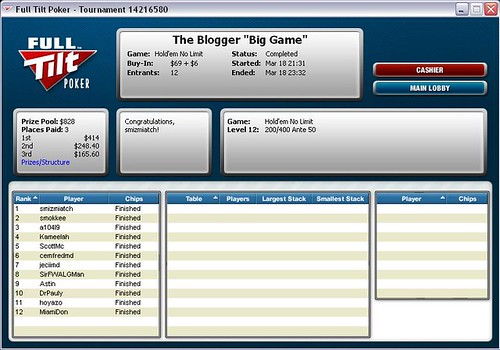
I figured out a well-known secret about how to win tournaments: Get great cards.
Twelve players showed up for MiamiDon's Big Game, which is always a fun tourney. I was able to build a huge chip lead and keep it all the way until the last hand, when I was dealt AA heads-up and rivered a needless set.
Check this out:
I played 242 hands. I was dealt AA twice, KK twice, QQ five (!) times, JJ twice and AK three times. Seriously, that's a sick run.
What's more, I only lost two hands the whole tournament that went to showdown. I got in with an open-ended straight draw in heads-up play against Smokee's top pair, and I lost one other hand vs. a shortstack with my 99 vs. his KQ. And that was it.
I made one straight, two sets and 10 two-pair hands.
I almost felt like my raises were getting too much respect, although I had the goods most of the time.
Even after all that, Smokee and third-place finisher BigPirate were never out of it. They played well, but my hands kept holding up.
So yeah, this tournament was fantastic! It's so much fun to wield a huge stack and not donk it away.
The Big Game win also accomplished several milestones for me: it's my first blogger tourney win, my first MTT win since I chopped a 56-player tourney at the Golden Nugget in 2004 and the first time I've ever busted Waffles.
If you don't already, check out the blogs of the players in this tournament. They're some of the best:
Smokkee
BigPirate
Derek
ScottMc
cemfredmd
jeciimd
Waffles
Astin
Dr. Pauly
Hoyazo
MiamiDon
Friday, March 16, 2007
Beating shorthanded limit HE
Wolverine No. 1, which I bought yesterday
I played a short session of $30/$60 6-max limit tonight and won a little bit. I think one of the best ways for me to win shorthanded limit games is to only play one table at a time.
At these limits, most players are loose and hyper-aggressive. Hand reading becomes more important than I realized previously.
I've enjoyed reading the following articles about keys to beating tough shorthanded limit games. I like the authors' advice about varying betting patterns and finding ways to weather the storm. I wish I had known some of these tips when I actually played limit regularly.
Q&A #14: Dealing with Tough Players in Short-Handed Limit Hold 'em, by Ed Miller
Q&A #60: Beating Hyper-Aggressive Limit Games, by Ed Miller
Book Exerpt: The Bet-Bet Line, from "Winning in Tough Hold 'em Games," by Nick "Stoxtrader" Grudzien and Geoff "Zobags" Herzog
Tips to Beat Online Tight-Aggressive but Still Popular Limit Hold 'em Games, by Peter Rus
Problem adjusting to aggression in SH games and very frustrated, from 2+2 forums
Wednesday, March 14, 2007
Two all-ins and a fold
I thought these three hands were pretty challenging. I'd be interested to hear comments from anyone who cares to give them.
I lost this first hand last week. I flopped a set of Aces on a all-hearts board, and then I decided to jam the flop after the small blind check-raised. I figured I was ahead of his hand range, which could include a lot of straight draws, flush draws and two pair hands. Even if I was behind, I had seven outs on the turn and 10 on the river to make a boat.
The way I see it, I either push all in on this flop, or I call the flop raise and a turn bet, then somehow find a fold on the river. I don't like that line at all though. Does anyone have a better idea?
Texas Hold'em NL $10/$20
*** HOLE CARDS ***
Dealt to Hero (button) Ac As
Hero raises $70
SB calls $60
BB calls $50
*** FLOP *** Ah, Kh, Qh
SB Checks
BB Checks
Hero Bets $175
SB Raises $350
BB Folds
Hero Raises $1,811 and is All in
SB Calls $1,636
*** TURN *** 3d
*** RIVER *** 2d
*** SUMMARY ***
SB had Jh 8h and wins $4,180 (Flush, ace high)
---
I really liked how this next hand turned out.
When the big river donkbet came out, I clicked on the guy's name and checked out his stats. It turns out that he was betting out every single river! He was also a pretty loose and aggressive player, and his actions in the hand simply didn't add up. He talked for a few minutes in the chat box about how I should have folded and just got lucky.
No-Limit Hold'em, $5/$10 BB (9 handed) Hand History Converter Tool from FlopTurnRiver.com (Format: HTML)
Preflop: Hero is Button with Qh, Kd. SB posts a blind of $5.
5 folds, CO calls $10, Button raises to $45, 2 folds, CO calls $35.
Flop: ($105) Qc, 6d, 2s (2 players)
CO checks, Button bets $80, CO calls $80.
Turn: ($265) 3c (2 players)
CO checks, Button bets $200, CO calls $200.
River: ($665) 8d (2 players)
CO calls $788.50 (All-In), Hero calls $463.50.
Final Pot: $1917
Results:
CO has Td Th (one pair, tens).
Hero has Qh Kd (one pair, queens).
Outcome: Hero wins $1917
.
---
This hand threw me a little because I couldn't understand what my opponent would limp-call with UTG preflop. My read on him was that he was the kind of player who would have raised JTs first in, and he definitely would have raised hands like AK and KQ. But I figure he would limp-call with JTo. It's hard to put him on exactly that hand though, especially given his suspicious preflop play and turn donkbet. Maybe I got bluffed:
No-Limit Hold'em, $5/10 BB (6 handed) Hand History Converter Tool from FlopTurnRiver.com (Format: HTML)
Preflop: Hero is CO with 9c, 9d. SB posts a blind of $5.
UTG calls $10, 1 fold, CO raises to $45, 3 folds, UTG calls $35.
Flop: ($105) Qs, Ks, Ac (2 players)
UTG checks, CO bets $80, UTG calls $80.
Turn: ($265) Kh (2 players)
UTG bets $250, Hero folds.
Final Pot: $515
Tuesday, March 13, 2007
"No Limit Hold 'em: Theory and Practice"
There's a lot of good advice about controlling the pot size in "No Limit Hold 'em: Theory and Practice," by David Sklansky and Ed Miller. It's a concept that's not well understood by many no limit players, and they're the ones who are most likely to overplay their stacks away.
That said, I have a few issues with some of the recommendations made in the book. Here are some examples:
_Don't be afraid to minimum raise, the authors write. They support their argument by saying that the minimum raise often effectively raises the table stakes because many players will treat it the same way as a limp.
"Often you should make this sort of raise with 'brave' hands -- pocket pairs, suited connectors, and suited aces -- hands that play well after the flop. The goal is to turn your $5-$10 game (or whatever limit you're playing) into a $10-$20 or $15-$30 game for for this hand only," the authors write.
Put simply, I completely disagree. When you make a minimum raise, this is exactly the kinds of hands your opponents will put you on. If your opponents can significantly narrow your hand range down, that cuts into your implied odds because it lessens the chance you will get paid off when you hit your hand.
_It's OK to overlimp with Aces, the book says.
Mathematically, I can see the value of limping with Aces occasionally, especially if you anticipate that one of your opponents will raise. That said, I do not believe that limping with Aces occasionally will make you more money than playing them strongly. Pocket Aces are the strongest hand in hold 'em, and you need to know when they're no good.
An overlimp preflop gives you little information about the strength of your opponents' hands, nor does it put money into the pot when you are sure you have the nuts.
_If your preflop raise is called behind you, check a lot of flops, according to the authors.
This is just plain wrong. Against most opponents and on most flops, a continuation bet will take down the pot, especially when heads-up. You can't win if you don't bet or raise.
_Turn bets should be smaller fractions of the pot than flop bets, they write.
The authors argue that bets don't need to be as large on the turn to make draws unprofitable.
I don't believe it. Most players will call a single flop bet with a strong draw. The flop bet does little to force them out of the hand. It's when you bring that large bet on the turn that you give your opponents the greatest opportunity to put in more money when they have the worst of it.
I could go on. The more I review this book, the less I like about it.
It advocates limping first in on the button with hands like J9. It says that with a $700 stack in a $5/10 game, you should not raise with pocket 8s first in from middle position. Basically, it encourages a brand of poker that's simply not practical in reality.
Sure, these plays can be effective in the right situations against the right opponents on the right flops. But in general, I think you're more likely to damage your own game by attempting to execute questionable plays in rare situations.
To be fair, there are some parts of this book that I really like.
I've found that giving free cards can be quite effective for inducing bluffs and building medium-sized pots against players who interpret your action as weakness. I agree with the many suggestions about how to make the most of your position. I found the instruction on what kinds of hands work best for squeeze plays informative.
Overall, there's a single measure I use to evaluate poker strategy books: How much of a better player does this book make me? I would say it helped me a little bit, but some of the more marginal recommendations make me doubt the authors' credibility.
After this book, I'm done reading no limit books by people who don't play it as their main game. Their analysis may be solid in "theory," but in "practice" this playing style would come off as weak-tight.
Friday, March 09, 2007
Smacked!
Well, I finally hit a rough patch, which was bound to happen at the 10/20 NL games I've been playing. Thankfully, my bankroll is an adequate cushion for these inevitable swings.
It would be one thing if I lost just because of bad beats, but I made some marginal bluffs and all-in bets myself. I had been running so hot that I almost took for granted that I would hit my flush draws or always get folds to my big bets. I forgot a little bit that I'm playing against some solid players who will make pretty accurate reads and make me pay for -EV plays in the long run.
And the long run is what it's all about anyway. Sure, I lost a few buy-ins. But we all know that it happens, and these downswings are insignificant compared to the big picture. I had a bad few hundred hands in which I didn't play my best and ran into some tough situations.
That's in the past. I'll step down to 5/10 for a few days to recover some of the losses, and then pick up right where I left off in a few days (hopefully).
Now it's back to the grind! You gotta love the grind.
---
In other news, congrats to Slb for taking down cc's heads-up challenge! There were 10 runners. I beat cc in my first match after a tough battle. Then Slb took me down in the next round in another back-and-forth match.
Heads-up play is a lot of fun. Cc said he was going to organize this thing again sometime soon, and I hope to see more people show up! In addition, it's one of the few weekday blogger events I'm able to attend because normally I'm still at work (due to the time change) when they're scheduled. This one didn't start till 11 p.m. EST, so I was able to make it.
Tuesday, March 06, 2007
More on preflop raising
Bob Tewksbury: What you are talking about here is what scouts and executives call “makeup.” High-achieving players play with confidence, have a short-term memory regarding past failures, keep their focus on the process of their actions rather than on the result, and minimize their achievements. Those players have the ideal baseball personality.
--Baseball Prospectus interview
I wanted to add a few notes to my previous post about preflop raising after Hoyazo linked me up. In general, I suggested re-raising a wide range of hands from late position with suited connectors, suited one-gappers, suited Aces, Broadway cards and some suited Kings.
But like any strategy in poker, this one is simply a general set of guidelines. There are exceptions to every rule, and if you do the same thing every time, your opponents will start to catch on.
Against tight calling stations, re-raising with some of those Axs, Kxs and lower offsuit broadway hands can turn into a mistake. You'll often be dominated, which can cost you a medium-size pot when you can't bet for value or successfully bluff.
Another situation when re-raising with marginal hands can be obviously wrong is against a short stack. By their nature, short stacks generally don't give good implied odds, meaning that your suited connectors and more marginal high card hands (those that contain a T or 9) can get you in trouble.
One idea I failed to make clear previously is what I meant when I wrote "3 betting." The terminology makes more sense in limit poker, where a limp/call is the first bet, a raise is the 2 bet, and a re-raise is the 3 bet. The same goes for no limit, although it takes a little more thought. Just remember that the first raise is the 2 bet and the second raise is the 3 bet. I wasn't advocating re-re-raising with suited connectors or low pocket pairs -- that's just crazy (much of the time).
The main point I want to make is that your reads on your opponents should dictate whether you re-raise or not. More often than not, raising or folding preflop is solid poker. But calling has its place, and it's important to look for those situations so that you don't trap yourself into playing a large pot with poor chances of winning.
Folding is also perfectly OK preflop, even sometimes when you think you have a playable hand. It costs very little to fold, and no one will ever know what you let go.
Monday, March 05, 2007
I'm a donkey. Just look at the numbers!
I went to Donkeytest.com a couple of months ago when I first heard about it, and I didn't do too well.
So I thought, "Well, maybe if I give it another try, I'll do better."
Nope. After taking the 52-question test a second time, my poker IQ came in at a pathetic 109. My first response was to blame the test for my poor score, but then I decided it would be better if I could find out what I did wrong and try to learn from it.
I went out searching and found a 2+2 thread that provides an answer key! Just what I wanted, although the test has been changed a little bit from the time when the key was made. Needless to say, it was very easy to improve my score once I knew the correct answers. :)
Here are a couple of the questions I got wrong the first time I took the test:
Initially I chose "raise to $1,600," but upon review I agree that the correct answer is "raise to $2,300." I fell into the common trap of trying to milk AA a little too much when a large raise will help define your hand and reduce your opponents' implied odds.
The correct answer is b, which I failed to get right because I just couldn't see the UTG player limping with AA. I mean, I know it happens all the time, but it's still pretty rare, in large part because it's usually a bad move.
Then all that minraising breaks out, and I don't know what to think about this hand anymore. When I found out the answer, it was easy to understand the rationale. But so many times, minraises are a sign of weakness rather than strength.
Many of the other questions I missed involved folding strong hands or making read-based decisions, which are hard to judge when seen on a Web site rather than at the table.
In general, the test is OK. I dispute a few of the answers, and I try hard to avoid tricky out of position situations where I would be forced to make a tough fold or call. The test would be more effective if it were longer, but I still don't think it would be an accurate measure of a poker player.
Like all IQ tests, I wonder: What is this thing supposed to be evaluating again? If it's supposed to test poker aptitude, I don't think it does a good job. For me and I'm sure many other players, the toughest situations used in the test come up rarely and can be such close calls that their answers don't necessarily reflect on the test-taker's underlying skills. That said, I understand the correlation between high scores and solid players. At least I feel like I learned something.
---
I've been wanting to post a couple of links from recent editions of Card Player magazine. Despite its flaws, I still enjoy reading it. Both of these columns come from Matt Matros:
_ Can I get away from this?
_ It's bad to be a space alien
So I thought, "Well, maybe if I give it another try, I'll do better."
Nope. After taking the 52-question test a second time, my poker IQ came in at a pathetic 109. My first response was to blame the test for my poor score, but then I decided it would be better if I could find out what I did wrong and try to learn from it.
I went out searching and found a 2+2 thread that provides an answer key! Just what I wanted, although the test has been changed a little bit from the time when the key was made. Needless to say, it was very easy to improve my score once I knew the correct answers. :)
Here are a couple of the questions I got wrong the first time I took the test:
18. Tournament. Blinds are 100-200. A novice call station raises UTG to $500. Unknown player flat calls in middle. You all have about 20,000 chips.
You are in the cutoff seat with:
Ah Ad
What should you do?
a) Call
b) Raise to $1,000
c) Raise to $1,600
d) Raise to $800
e) Raise to $2,300.
Initially I chose "raise to $1,600," but upon review I agree that the correct answer is "raise to $2,300." I fell into the common trap of trying to milk AA a little too much when a large raise will help define your hand and reduce your opponents' implied odds.
43. Tournament. Blinds are 300-600 with 75 antes. 9 handed.
SB is a well known tourney pro and has 60,000 chips. A weak tight player UTG with 100,000 chips limps and SB completes. Big blind with 12,000 chips checks.
Flop: 8s 6s 3d
Blinds fold to UTG who bets 3,000. SB calls and the BB min check raises to 6,000. UTG min re-raises to 12,000. After long consideration SB calls, and the big blind calls all-in.
Turn: Kh
SB checks. UTG checks.
River: 3s
SB bets 10,000 into the 40,000 chip pot. UTG quickly calls. What did all three players hold?
a) SB had AA, UTG has a flush draw, and BB holds a set.
b) SB had a draw, BB had two pair on the flop, and UTG has AA
c) SB had a set, BB has 99+, and UTG has a flush draw
d) SB had two pair on the flop, BB has a draw, UTG has A8.
The correct answer is b, which I failed to get right because I just couldn't see the UTG player limping with AA. I mean, I know it happens all the time, but it's still pretty rare, in large part because it's usually a bad move.
Then all that minraising breaks out, and I don't know what to think about this hand anymore. When I found out the answer, it was easy to understand the rationale. But so many times, minraises are a sign of weakness rather than strength.
Many of the other questions I missed involved folding strong hands or making read-based decisions, which are hard to judge when seen on a Web site rather than at the table.
In general, the test is OK. I dispute a few of the answers, and I try hard to avoid tricky out of position situations where I would be forced to make a tough fold or call. The test would be more effective if it were longer, but I still don't think it would be an accurate measure of a poker player.
Like all IQ tests, I wonder: What is this thing supposed to be evaluating again? If it's supposed to test poker aptitude, I don't think it does a good job. For me and I'm sure many other players, the toughest situations used in the test come up rarely and can be such close calls that their answers don't necessarily reflect on the test-taker's underlying skills. That said, I understand the correlation between high scores and solid players. At least I feel like I learned something.
---
I've been wanting to post a couple of links from recent editions of Card Player magazine. Despite its flaws, I still enjoy reading it. Both of these columns come from Matt Matros:
_ Can I get away from this?
_ It's bad to be a space alien
Subscribe to:
Posts (Atom)

