April is going well so far. I'm playing better poker, and I'm up a couple of buy-ins.
I noticed that I'd been folding to continuation bets around 75-80 percent of the time, and even more at some tables. I figured the way to fix this problem wasn't to call more continuation bets, but to raise more preflop.
This means that I've been putting in a third raise with some medium-strength hands in addition to AA and KK. I've found it necessary to four-bet light when your opponents are three-betting you light. So far, they've folded every time! The fourth bet means Aces, right? One guy typed in chat that he laid down TT preflop to my re-re-raise when I held J9s. He would've folded to my continuation bet anyway.
One problem with this strategy is that it won't take long for people to start looking me up. So I'll need to be sure to also make a third raise with AA and KK when I'm against people who have seen me raise a lot recently.
Hero ($1998)
Villain ($2599)
dealt to Hero [9s Js]
Hero raises to $70
Villain raises to $180
Hero raises to $500
Villain folds
Returned uncalled bets $320 to Hero
Hero collected $390 from Main pot
Monday, April 09, 2007


Tuesday, April 03, 2007
Scattered Strategems
I've been looking back over some hand histories of the last two weeks in an effort to derive some value from the beats. I realized that many of the times when I lost, I made errors when I should have known better. I guess it takes repetition for some poker lessons to sink in.
So I wanted to list some common-sense poker guidelines that I find are easy to forget in the heat of the moment. Maybe if I write them down, I won't be as likely to forget them again:
_ Ace-King is a very good preflop hand, but it's usually not worth pushing all in with preflop in cash games. Sure there's a time and a place for it, especially when I want to four-bet/squeeze play/resteal with dead money trapped between you and the initial raiser. But most of the time, I'll either win a small pot or lose a big one. The only hands that will call have me crushed -- AA or KK.
_ Game selection is perhaps the most important poker skill. It isn't hard to spend time to find good tables, especially with the aid of PokerTracker and PokerAce. I'm not here to become the best poker player in the world; I'm here to grow my bankroll and make as much money as I can. I believe that it's untrue that you need to play strong players in order to learn. I learn just as much from the fish. There are often good players near the fish anyway, but that doesn't mean I want to get involved in many hands with them.
_ Ax suited simply doesn't play well out of position, even many times when I think I have odds to call.
_ I should put in a raise at some point when I'm way ahead or way behind, especially when I may be dominated. The raise will either take down the pot, tell me I'm beaten, or buy me a free showdown. Cally cally won't fly in Vegas.
_ All-in bets are sometimes more likely to get called than large pot-sized bets because they look more like bluffs.
_ While a loose-aggressive image may be my goal in shorthanded NL games, it's merely a means to an end. No matter what style I play, most of my profits will come from recognizing and taking advantage of my opponents' mistakes.
_ If I check the turn with a weak hand I think is likely best, I must call a river bet most of the time because my check will frequently induce bluffs no matter what card falls.
Those are rather scattered items, but I wanted to get them down in writing. Good luck at the tables! Go Braves!
Sunday, April 01, 2007
March Review
Ug, March sucked poker-wise. It was my first down month since December 2005, with most of those losses coming in the last week when I dropped more than $7,000 while chasing a $300 bonus on Full Tilt.
I feel like such an idiot. I fully recovered from a downswing at the beginning of the month, but then I suffered some bad beats. Then I made some stupid calls and failed big bluffs, and poof!, there go my profits. Overall, I finished the month down about $2,000, which isn't too bad.
My play yesterday shows why I'm upset with myself. I had been thinking earlier about the merits of cold calling with AK from the big blind and then check-raising when you hit. Of course, I fell for that exact play when I held Ace-rag on an Ace-high flop. For some reason, I couldn't find the fold button. Then on another hand, I thought I had flopped trip 2s off K2 from the big blind. Unfortunately, I had misread my hand and I actually had K6.
Obviously, I'm not thinking straight. These are rookie mistakes.
The reasons for this are lack of confidence, poor analytical reasoning, impatience, fancy play syndrome and the wearing down effect of the grind. In addition, the large dollar amounts of the 10/20 NL games got to me, even though I should know better. Everything should be measured in buy-ins and big bets, not dollar figures.
I usually can accept losses that happen due to bad luck, but I can't stand it when it's my fault for shitty play!
Fortunately, it's a new month. Enough of this whining and irrational blather. None of this crap should affect my game. If it continues to, I simply won't play. Carry on; nothing to see here.
Tuesday, March 27, 2007
Why yes, I did read through 2+2 today. How did you guess?
So Neteller has now decided to stop doing business in Canada as well as the U.S., and no one seems to know exactly why. This is pure speculation, but maybe Neteller agreed to this condition as part of a forthcoming agreement with U.S. authorities. If that's the case, then perhaps we'll hear some good news about money being released sometime soon. I only have $9 tied up there, but I know many other people have much more significant amounts that they can't get it.
Neteller's behavior -- as well as many other ewallets and poker sites -- has always seemed baffling at first glance. But I've come to believe the generally accepted wisdom that businesses are tremendously risk-averse even if they're founded on gambling. Just because poker players should usually opt for the highest-value play without regard to risk doesn't mean poker sites will subscribe to the same belief. And who knows, maybe we will get a poker exemption to the UIGEA someday.
I also found it interesting to hear that Planet Poker, the first online poker room that offered real money games in 1998, is ceasing operations because of the impacts of the UIGEA. As Grinder suggested, Planet Poker didn't upgrade or change with the times. Sure, they may have been first. But I never played there, and I only ever read about it in nostalgic Roy Cooke columns in CardPlayer. Even so, it's sad to see a poker site bite it.
Finally, Lee Jones is leaving his job as poker room manager for PokerStars. I always liked making fun of Jones for no good reason. Maybe it's because he's the face of a bad beat -- a goofy smiling dude who doesn't give a shit because all of your money are belong to PokerStars anyway. That said, he seemed like a great ambassador for the game, and I enjoyed his small stakes limit book when I read it in Santiago.
Monday, March 26, 2007
Betting the turn
Some good discussion on turn bet sizing came out of a strategy post by Hoyazo last week. Read it.
The question was about whether turn bets should be a smaller proportion of the pot because you want to encourage your opponents to call when they don't have the odds to see the river with most draws.
I believe turn bets need to be significant in size most of the time. I recommend this CardPlayer article by Bob Ciaffone: "No-Limit Hold 'em Turn Betting: If you bet the turn, bet big."
The main reason I like bets between 1/2 pot and full pot bets on the turn is that they put your opponents in tough situations. Sure, if you bet 1/3 pot and your opponent calls with a flush draw, he's making an error because he'll only hit about one in five times. But it's not a very large error, especially since you may occasionally have to pay off a river bet when the flush card comes. Why not bet larger amounts, so that your opponents are making even bigger mistakes when they chase their draws?
Yes, sometimes you will fold out weak drawing hands that would have paid a smallish amount to see the river. But I think that money is made up for with the times that those weak hands will also call a larger amount. In addition, people do strange things sometimes with flush draws when facing significant bets on the turn -- like going all in, which is ideal if you can make the call.
Smaller turn bets look weak, they give implied odds and I'm not convinced that they have a greater expected value. For example, if an opponent will call a 1/3 pot bet of $100 half the time but a full pot bet of $300 a quarter of the time, you're better off betting full pot ($50 vs. $75).
A final argument is that it would be all well and good to make a smaller turn bet if you knew exactly that your opponent had a naked flush draw. But what about the times he has a flush draw and a pair? What if you're facing multiple opponents whose combined draws cut into your equity? For those situations, larger bets are necessary.
Here are a few more comments that I made in the comments section of Hoy's post:
---
I played in the $400K Guaranteed tourney on Full Tilt today and went out short of the money. I played pretty well early but then got distracted by a fantasy baseball draft, which caused me to tighten up.
Anyway, I eventually got to the point where I pushed with AK when my M was 4.59. Don't worry -- this isn't just a bad beat story:
FullTiltPoker $400,000 Guarantee (14978671), Table 189 - 140/280 Ante 25
Seat 1: GB2005 (8,440)
Seat 4: smizmiatch (2,985)
Dealt to smizmiatch [Ac Kh]
GB2005 raises to 840
smizmiatch raises to 2,960, and is all in
GB2005 calls 2,120
smizmiatch shows [Ac Kh]
GB2005 shows [Ad Td]
fraentsch: flop call
*** FLOP *** [Qs 5s 5d]
*** TURN *** [Qs 5s 5d] [2d]
*** RIVER *** [Qs 5s 5d 2d] [Jd]
smizmiatch shows a pair of Fives
GB2005 shows a flush, Ace high
GB2005 wins the pot (6,565) with a flush, Ace high
Now, my tournament game certainly needs work. I'd like to hear comments on whether there's any merit to using a stop-and-go play on a hand like this.
If I had smooth called preflop and then pushed the flop, I maybe would have won the hand right there. Is that a viable option? When should it be used? Thanks for the feedback.
The question was about whether turn bets should be a smaller proportion of the pot because you want to encourage your opponents to call when they don't have the odds to see the river with most draws.
I believe turn bets need to be significant in size most of the time. I recommend this CardPlayer article by Bob Ciaffone: "No-Limit Hold 'em Turn Betting: If you bet the turn, bet big."
The main reason I like bets between 1/2 pot and full pot bets on the turn is that they put your opponents in tough situations. Sure, if you bet 1/3 pot and your opponent calls with a flush draw, he's making an error because he'll only hit about one in five times. But it's not a very large error, especially since you may occasionally have to pay off a river bet when the flush card comes. Why not bet larger amounts, so that your opponents are making even bigger mistakes when they chase their draws?
Yes, sometimes you will fold out weak drawing hands that would have paid a smallish amount to see the river. But I think that money is made up for with the times that those weak hands will also call a larger amount. In addition, people do strange things sometimes with flush draws when facing significant bets on the turn -- like going all in, which is ideal if you can make the call.
Smaller turn bets look weak, they give implied odds and I'm not convinced that they have a greater expected value. For example, if an opponent will call a 1/3 pot bet of $100 half the time but a full pot bet of $300 a quarter of the time, you're better off betting full pot ($50 vs. $75).
A final argument is that it would be all well and good to make a smaller turn bet if you knew exactly that your opponent had a naked flush draw. But what about the times he has a flush draw and a pair? What if you're facing multiple opponents whose combined draws cut into your equity? For those situations, larger bets are necessary.
Here are a few more comments that I made in the comments section of Hoy's post:
On the turn, I disagree with the general advice that smaller bets are better. I like to bet more on the turn, usually between 3/4 pot and full pot. That's because the turn is where the big bets start coming out and where your opponents will be paying the highest price for a foolish call to see the river. It's also a better opportunity to get value for your made hands than on the flop.This post also started a mini-debate about the merits of not folding flush draws on the flop when faced with a full pot bet. I want to do some PokerTracker research and write more about it soon. Another point to consider is that tournament vs. cash game considerations may alter strategy. For purposes of this post, assume that all players have 100 BB stacks.
The way I see it, the purpose of flop bets is to build large pots, take down small pots and find out where you stand.
Turn bets are used to pressure your opponents to make tough and incorrect decisions. Larger turn bets have more value when your opponents try to suck out. These big bets have a greater chance of taking down the pot against top pair. They reduce the chances of seeing what could be an expensive river. They more clearly define your opponent's hand.
---
I played in the $400K Guaranteed tourney on Full Tilt today and went out short of the money. I played pretty well early but then got distracted by a fantasy baseball draft, which caused me to tighten up.
Anyway, I eventually got to the point where I pushed with AK when my M was 4.59. Don't worry -- this isn't just a bad beat story:
FullTiltPoker $400,000 Guarantee (14978671), Table 189 - 140/280 Ante 25
Seat 1: GB2005 (8,440)
Seat 4: smizmiatch (2,985)
Dealt to smizmiatch [Ac Kh]
GB2005 raises to 840
smizmiatch raises to 2,960, and is all in
GB2005 calls 2,120
smizmiatch shows [Ac Kh]
GB2005 shows [Ad Td]
fraentsch: flop call
*** FLOP *** [Qs 5s 5d]
*** TURN *** [Qs 5s 5d] [2d]
*** RIVER *** [Qs 5s 5d 2d] [Jd]
smizmiatch shows a pair of Fives
GB2005 shows a flush, Ace high
GB2005 wins the pot (6,565) with a flush, Ace high
Now, my tournament game certainly needs work. I'd like to hear comments on whether there's any merit to using a stop-and-go play on a hand like this.
If I had smooth called preflop and then pushed the flop, I maybe would have won the hand right there. Is that a viable option? When should it be used? Thanks for the feedback.
Friday, March 23, 2007
Bad Beat of the Week
I'm thinking about posting a weekly bad beat hand. Yeah, yeah, I know nobody cares. But it might be a fun opportunity to rant a little bit.
And hopefully it can also show people that the games are still good when people are making these kinds of horrible plays. On to the hand!
I was having a rough session when the following situation came up. The villain in this hand was a loose-passive nimwit with stats of 43/5/3. I folded to his check-raises the first couple of times, but you have to draw a line. Sometimes, fish start to smell like bullshit.
$10/$20 - No Limit Hold'em
Villain is BB ($853)
Hero ($2,000)
Dealt to Hero [As Kc] (woohoo, I've got a hand!)
Hero raises to $70
Villain calls $50
*** FLOP *** [4h Ks 5s]
Villain checks
Hero bets $125 (And my hand hit!)
Villain raises to $783, and is all in (But wtf!!! What is this idiot doing? #@&%! Well, he has less than half a stack, and I'm not folding against this donk)
Hero calls $658
Villain shows [6c 4s] (Wtf again! 6...4...offsuit)
Hero shows [As Kc]
*** TURN *** [4h Ks 5s] [6s] (Of course he hits)
*** RIVER *** [4h Ks 5s 6s] [3c]
Villain shows two pair, Sixes and Fours
Hero shows a pair of Kings
Villain wins the pot ($1,713) with two pair, Sixes and Fours
I don't know exactly what happened here. I guess I had a tight image at this table, and the donk bastard thought he could get me to fold yet again. It's just not going to happen in that situation.
Oh well... I was only a 78 percent favorite anyway.
---
Edit: I almost forgot to pimp this weekend's tourneys. I'll be playing in the WPBT Razz event on Sunday, as well as the $400K Guaranteed, which kuro satellited into earlier this week.

And hopefully it can also show people that the games are still good when people are making these kinds of horrible plays. On to the hand!
I was having a rough session when the following situation came up. The villain in this hand was a loose-passive nimwit with stats of 43/5/3. I folded to his check-raises the first couple of times, but you have to draw a line. Sometimes, fish start to smell like bullshit.
$10/$20 - No Limit Hold'em
Villain is BB ($853)
Hero ($2,000)
Dealt to Hero [As Kc] (woohoo, I've got a hand!)
Hero raises to $70
Villain calls $50
*** FLOP *** [4h Ks 5s]
Villain checks
Hero bets $125 (And my hand hit!)
Villain raises to $783, and is all in (But wtf!!! What is this idiot doing? #@&%! Well, he has less than half a stack, and I'm not folding against this donk)
Hero calls $658
Villain shows [6c 4s] (Wtf again! 6...4...offsuit)
Hero shows [As Kc]
*** TURN *** [4h Ks 5s] [6s] (Of course he hits)
*** RIVER *** [4h Ks 5s 6s] [3c]
Villain shows two pair, Sixes and Fours
Hero shows a pair of Kings
Villain wins the pot ($1,713) with two pair, Sixes and Fours
I don't know exactly what happened here. I guess I had a tight image at this table, and the donk bastard thought he could get me to fold yet again. It's just not going to happen in that situation.
Oh well... I was only a 78 percent favorite anyway.
http://twodimes.net/h/?z=2524472Fish will pay me back. They always do.
pokenum -h as kc - 6c 4s -- 4h ks 5s
Holdem Hi: 990 enumerated boards containing Ks 5s 4h
cards win %win lose %lose tie %tie EV
As Kc 771 77.88 219 22.12 0 0.00 0.779
4s 6c 219 22.12 771 77.88 0 0.00 0.221
---
Edit: I almost forgot to pimp this weekend's tourneys. I'll be playing in the WPBT Razz event on Sunday, as well as the $400K Guaranteed, which kuro satellited into earlier this week.
Wednesday, March 21, 2007
Pregame
I almost never post before sitting down at the tables for the evening, but perhaps it will put me in the right mindset before I play.
I played pretty damn poorly last night and went on tilt. Don't laugh too hard about the following hand. It was a terrible play:
Dealt to Hero 2h, 2s
Hero raises $35
CO calls $35
Villain/button raises to $180
Hero calls $145
CO folds.
*** Dealing Flop *** 5c, 3s, 9c
Hero checks.
Villain bets $250
Hero is all-In.
Villain calls $673.21
*** Dealing Turn *** Qc
*** Dealing River *** Jh
Villain shows Ac, Ah a pair of Aces.
Villain wins $2254.42 from the main pot with a pair of Aces.
That's right -- I check-raised all-in with a pocket pair of 2s that missed. At the time, I was thinking there was a good chance my opponent had a hand like AK or AQ. Unfortunately, I was wrong and got stacked for $1,000 when I should have just folded the flop. If there's any silver lining to this hand, it's that I realized how stupid it is to try to represent a set by check-raising all in on the flop. No one is going to believe me, especially when they hold AA!
Let us never speak of that hand again.
So tonight, I'm doing things right. I'm watching a CardRunners video before I play. I'm making sure I'll only play in fishy games. Most of all, I'll tighten up a little until I get ahead.
One problem I've been having recently is dealing with aggressive three-betters out of the blinds. I've been losing every time they have a good hand. Even when they don't have a good hand, they've been hitting the flop. There's an easy solution to this problem. I can just fold preflop with some of my more marginal hands that may well be dominated, or I could reraise all in against the true maniacs.
Another difficulty is that when I try to resteal/squeeze play from the blinds, I seem to get called and lose. Out of position squeeze plays don't seem to be +EV recently against players who know I have an aggressive image. To fix this problem, I'll focus even more heavily on playing in position.
In general, my concentration has been spotty over the last couple of weeks, and it has shown in my results. I always plan on playing my best game when I start a session, but often halfway in I can tell that I'm not at my best. Sometimes I have the discipline to stop right then, but most of the time I'll wait until I've reached the two-hour mark before quitting. I'm such a dumbass.
But I keep telling myself that all that crap is in the past. It has no relevance to how I play tonight, except as a motivational tool.
One of the reasons for my big improvement last fall was that I realized I could win a ton more money if I could eliminate idiotic mistakes from my game. Those errors are starting to creep back in, and I want to choke them off right here and now.
Edit: I played OK and lost a small amount. Hey, you can't make cards come.
Monday, March 19, 2007
Big Game Win!
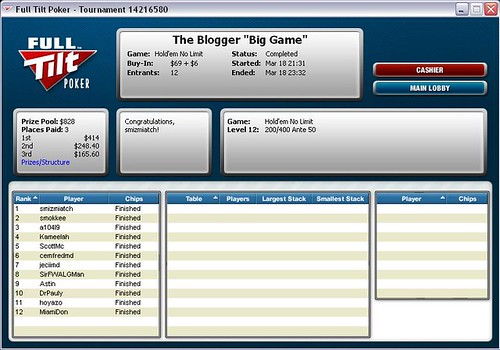
I figured out a well-known secret about how to win tournaments: Get great cards.
Twelve players showed up for MiamiDon's Big Game, which is always a fun tourney. I was able to build a huge chip lead and keep it all the way until the last hand, when I was dealt AA heads-up and rivered a needless set.
Check this out:
I played 242 hands. I was dealt AA twice, KK twice, QQ five (!) times, JJ twice and AK three times. Seriously, that's a sick run.
What's more, I only lost two hands the whole tournament that went to showdown. I got in with an open-ended straight draw in heads-up play against Smokee's top pair, and I lost one other hand vs. a shortstack with my 99 vs. his KQ. And that was it.
I made one straight, two sets and 10 two-pair hands.
I almost felt like my raises were getting too much respect, although I had the goods most of the time.
Even after all that, Smokee and third-place finisher BigPirate were never out of it. They played well, but my hands kept holding up.
So yeah, this tournament was fantastic! It's so much fun to wield a huge stack and not donk it away.
The Big Game win also accomplished several milestones for me: it's my first blogger tourney win, my first MTT win since I chopped a 56-player tourney at the Golden Nugget in 2004 and the first time I've ever busted Waffles.
If you don't already, check out the blogs of the players in this tournament. They're some of the best:
Smokkee
BigPirate
Derek
ScottMc
cemfredmd
jeciimd
Waffles
Astin
Dr. Pauly
Hoyazo
MiamiDon
Friday, March 16, 2007
Beating shorthanded limit HE
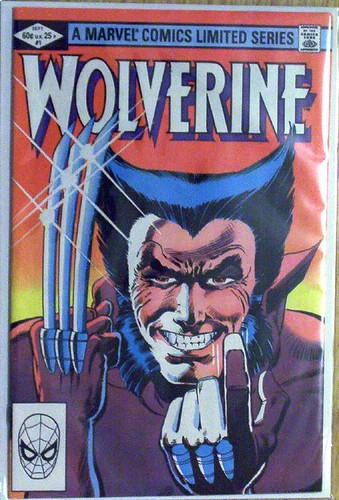
Wolverine No. 1, which I bought yesterday
I played a short session of $30/$60 6-max limit tonight and won a little bit. I think one of the best ways for me to win shorthanded limit games is to only play one table at a time.
At these limits, most players are loose and hyper-aggressive. Hand reading becomes more important than I realized previously.
I've enjoyed reading the following articles about keys to beating tough shorthanded limit games. I like the authors' advice about varying betting patterns and finding ways to weather the storm. I wish I had known some of these tips when I actually played limit regularly.
Q&A #14: Dealing with Tough Players in Short-Handed Limit Hold 'em, by Ed Miller
Q&A #60: Beating Hyper-Aggressive Limit Games, by Ed Miller
Book Exerpt: The Bet-Bet Line, from "Winning in Tough Hold 'em Games," by Nick "Stoxtrader" Grudzien and Geoff "Zobags" Herzog
Tips to Beat Online Tight-Aggressive but Still Popular Limit Hold 'em Games, by Peter Rus
Problem adjusting to aggression in SH games and very frustrated, from 2+2 forums
Wednesday, March 14, 2007
Two all-ins and a fold
I thought these three hands were pretty challenging. I'd be interested to hear comments from anyone who cares to give them.
I lost this first hand last week. I flopped a set of Aces on a all-hearts board, and then I decided to jam the flop after the small blind check-raised. I figured I was ahead of his hand range, which could include a lot of straight draws, flush draws and two pair hands. Even if I was behind, I had seven outs on the turn and 10 on the river to make a boat.
The way I see it, I either push all in on this flop, or I call the flop raise and a turn bet, then somehow find a fold on the river. I don't like that line at all though. Does anyone have a better idea?
Texas Hold'em NL $10/$20
*** HOLE CARDS ***
Dealt to Hero (button) Ac As
Hero raises $70
SB calls $60
BB calls $50
*** FLOP *** Ah, Kh, Qh
SB Checks
BB Checks
Hero Bets $175
SB Raises $350
BB Folds
Hero Raises $1,811 and is All in
SB Calls $1,636
*** TURN *** 3d
*** RIVER *** 2d
*** SUMMARY ***
SB had Jh 8h and wins $4,180 (Flush, ace high)
---
I really liked how this next hand turned out.
When the big river donkbet came out, I clicked on the guy's name and checked out his stats. It turns out that he was betting out every single river! He was also a pretty loose and aggressive player, and his actions in the hand simply didn't add up. He talked for a few minutes in the chat box about how I should have folded and just got lucky.
No-Limit Hold'em, $5/$10 BB (9 handed) Hand History Converter Tool from FlopTurnRiver.com (Format: HTML)
Preflop: Hero is Button with Qh, Kd. SB posts a blind of $5.
5 folds, CO calls $10, Button raises to $45, 2 folds, CO calls $35.
Flop: ($105) Qc, 6d, 2s (2 players)
CO checks, Button bets $80, CO calls $80.
Turn: ($265) 3c (2 players)
CO checks, Button bets $200, CO calls $200.
River: ($665) 8d (2 players)
CO calls $788.50 (All-In), Hero calls $463.50.
Final Pot: $1917
Results:
CO has Td Th (one pair, tens).
Hero has Qh Kd (one pair, queens).
Outcome: Hero wins $1917
.
---
This hand threw me a little because I couldn't understand what my opponent would limp-call with UTG preflop. My read on him was that he was the kind of player who would have raised JTs first in, and he definitely would have raised hands like AK and KQ. But I figure he would limp-call with JTo. It's hard to put him on exactly that hand though, especially given his suspicious preflop play and turn donkbet. Maybe I got bluffed:
No-Limit Hold'em, $5/10 BB (6 handed) Hand History Converter Tool from FlopTurnRiver.com (Format: HTML)
Preflop: Hero is CO with 9c, 9d. SB posts a blind of $5.
UTG calls $10, 1 fold, CO raises to $45, 3 folds, UTG calls $35.
Flop: ($105) Qs, Ks, Ac (2 players)
UTG checks, CO bets $80, UTG calls $80.
Turn: ($265) Kh (2 players)
UTG bets $250, Hero folds.
Final Pot: $515
Tuesday, March 13, 2007
"No Limit Hold 'em: Theory and Practice"
There's a lot of good advice about controlling the pot size in "No Limit Hold 'em: Theory and Practice," by David Sklansky and Ed Miller. It's a concept that's not well understood by many no limit players, and they're the ones who are most likely to overplay their stacks away.
That said, I have a few issues with some of the recommendations made in the book. Here are some examples:
_Don't be afraid to minimum raise, the authors write. They support their argument by saying that the minimum raise often effectively raises the table stakes because many players will treat it the same way as a limp.
"Often you should make this sort of raise with 'brave' hands -- pocket pairs, suited connectors, and suited aces -- hands that play well after the flop. The goal is to turn your $5-$10 game (or whatever limit you're playing) into a $10-$20 or $15-$30 game for for this hand only," the authors write.
Put simply, I completely disagree. When you make a minimum raise, this is exactly the kinds of hands your opponents will put you on. If your opponents can significantly narrow your hand range down, that cuts into your implied odds because it lessens the chance you will get paid off when you hit your hand.
_It's OK to overlimp with Aces, the book says.
Mathematically, I can see the value of limping with Aces occasionally, especially if you anticipate that one of your opponents will raise. That said, I do not believe that limping with Aces occasionally will make you more money than playing them strongly. Pocket Aces are the strongest hand in hold 'em, and you need to know when they're no good.
An overlimp preflop gives you little information about the strength of your opponents' hands, nor does it put money into the pot when you are sure you have the nuts.
_If your preflop raise is called behind you, check a lot of flops, according to the authors.
This is just plain wrong. Against most opponents and on most flops, a continuation bet will take down the pot, especially when heads-up. You can't win if you don't bet or raise.
_Turn bets should be smaller fractions of the pot than flop bets, they write.
The authors argue that bets don't need to be as large on the turn to make draws unprofitable.
I don't believe it. Most players will call a single flop bet with a strong draw. The flop bet does little to force them out of the hand. It's when you bring that large bet on the turn that you give your opponents the greatest opportunity to put in more money when they have the worst of it.
I could go on. The more I review this book, the less I like about it.
It advocates limping first in on the button with hands like J9. It says that with a $700 stack in a $5/10 game, you should not raise with pocket 8s first in from middle position. Basically, it encourages a brand of poker that's simply not practical in reality.
Sure, these plays can be effective in the right situations against the right opponents on the right flops. But in general, I think you're more likely to damage your own game by attempting to execute questionable plays in rare situations.
To be fair, there are some parts of this book that I really like.
I've found that giving free cards can be quite effective for inducing bluffs and building medium-sized pots against players who interpret your action as weakness. I agree with the many suggestions about how to make the most of your position. I found the instruction on what kinds of hands work best for squeeze plays informative.
Overall, there's a single measure I use to evaluate poker strategy books: How much of a better player does this book make me? I would say it helped me a little bit, but some of the more marginal recommendations make me doubt the authors' credibility.
After this book, I'm done reading no limit books by people who don't play it as their main game. Their analysis may be solid in "theory," but in "practice" this playing style would come off as weak-tight.
Friday, March 09, 2007
Smacked!
Well, I finally hit a rough patch, which was bound to happen at the 10/20 NL games I've been playing. Thankfully, my bankroll is an adequate cushion for these inevitable swings.
It would be one thing if I lost just because of bad beats, but I made some marginal bluffs and all-in bets myself. I had been running so hot that I almost took for granted that I would hit my flush draws or always get folds to my big bets. I forgot a little bit that I'm playing against some solid players who will make pretty accurate reads and make me pay for -EV plays in the long run.
And the long run is what it's all about anyway. Sure, I lost a few buy-ins. But we all know that it happens, and these downswings are insignificant compared to the big picture. I had a bad few hundred hands in which I didn't play my best and ran into some tough situations.
That's in the past. I'll step down to 5/10 for a few days to recover some of the losses, and then pick up right where I left off in a few days (hopefully).
Now it's back to the grind! You gotta love the grind.
---
In other news, congrats to Slb for taking down cc's heads-up challenge! There were 10 runners. I beat cc in my first match after a tough battle. Then Slb took me down in the next round in another back-and-forth match.
Heads-up play is a lot of fun. Cc said he was going to organize this thing again sometime soon, and I hope to see more people show up! In addition, it's one of the few weekday blogger events I'm able to attend because normally I'm still at work (due to the time change) when they're scheduled. This one didn't start till 11 p.m. EST, so I was able to make it.
Tuesday, March 06, 2007
More on preflop raising
Bob Tewksbury: What you are talking about here is what scouts and executives call “makeup.” High-achieving players play with confidence, have a short-term memory regarding past failures, keep their focus on the process of their actions rather than on the result, and minimize their achievements. Those players have the ideal baseball personality.
--Baseball Prospectus interview
I wanted to add a few notes to my previous post about preflop raising after Hoyazo linked me up. In general, I suggested re-raising a wide range of hands from late position with suited connectors, suited one-gappers, suited Aces, Broadway cards and some suited Kings.
But like any strategy in poker, this one is simply a general set of guidelines. There are exceptions to every rule, and if you do the same thing every time, your opponents will start to catch on.
Against tight calling stations, re-raising with some of those Axs, Kxs and lower offsuit broadway hands can turn into a mistake. You'll often be dominated, which can cost you a medium-size pot when you can't bet for value or successfully bluff.
Another situation when re-raising with marginal hands can be obviously wrong is against a short stack. By their nature, short stacks generally don't give good implied odds, meaning that your suited connectors and more marginal high card hands (those that contain a T or 9) can get you in trouble.
One idea I failed to make clear previously is what I meant when I wrote "3 betting." The terminology makes more sense in limit poker, where a limp/call is the first bet, a raise is the 2 bet, and a re-raise is the 3 bet. The same goes for no limit, although it takes a little more thought. Just remember that the first raise is the 2 bet and the second raise is the 3 bet. I wasn't advocating re-re-raising with suited connectors or low pocket pairs -- that's just crazy (much of the time).
The main point I want to make is that your reads on your opponents should dictate whether you re-raise or not. More often than not, raising or folding preflop is solid poker. But calling has its place, and it's important to look for those situations so that you don't trap yourself into playing a large pot with poor chances of winning.
Folding is also perfectly OK preflop, even sometimes when you think you have a playable hand. It costs very little to fold, and no one will ever know what you let go.
Monday, March 05, 2007
I'm a donkey. Just look at the numbers!
I went to Donkeytest.com a couple of months ago when I first heard about it, and I didn't do too well.
So I thought, "Well, maybe if I give it another try, I'll do better."
Nope. After taking the 52-question test a second time, my poker IQ came in at a pathetic 109. My first response was to blame the test for my poor score, but then I decided it would be better if I could find out what I did wrong and try to learn from it.
I went out searching and found a 2+2 thread that provides an answer key! Just what I wanted, although the test has been changed a little bit from the time when the key was made. Needless to say, it was very easy to improve my score once I knew the correct answers. :)
Here are a couple of the questions I got wrong the first time I took the test:
Initially I chose "raise to $1,600," but upon review I agree that the correct answer is "raise to $2,300." I fell into the common trap of trying to milk AA a little too much when a large raise will help define your hand and reduce your opponents' implied odds.
The correct answer is b, which I failed to get right because I just couldn't see the UTG player limping with AA. I mean, I know it happens all the time, but it's still pretty rare, in large part because it's usually a bad move.
Then all that minraising breaks out, and I don't know what to think about this hand anymore. When I found out the answer, it was easy to understand the rationale. But so many times, minraises are a sign of weakness rather than strength.
Many of the other questions I missed involved folding strong hands or making read-based decisions, which are hard to judge when seen on a Web site rather than at the table.
In general, the test is OK. I dispute a few of the answers, and I try hard to avoid tricky out of position situations where I would be forced to make a tough fold or call. The test would be more effective if it were longer, but I still don't think it would be an accurate measure of a poker player.
Like all IQ tests, I wonder: What is this thing supposed to be evaluating again? If it's supposed to test poker aptitude, I don't think it does a good job. For me and I'm sure many other players, the toughest situations used in the test come up rarely and can be such close calls that their answers don't necessarily reflect on the test-taker's underlying skills. That said, I understand the correlation between high scores and solid players. At least I feel like I learned something.
---
I've been wanting to post a couple of links from recent editions of Card Player magazine. Despite its flaws, I still enjoy reading it. Both of these columns come from Matt Matros:
_ Can I get away from this?
_ It's bad to be a space alien
So I thought, "Well, maybe if I give it another try, I'll do better."
Nope. After taking the 52-question test a second time, my poker IQ came in at a pathetic 109. My first response was to blame the test for my poor score, but then I decided it would be better if I could find out what I did wrong and try to learn from it.
I went out searching and found a 2+2 thread that provides an answer key! Just what I wanted, although the test has been changed a little bit from the time when the key was made. Needless to say, it was very easy to improve my score once I knew the correct answers. :)
Here are a couple of the questions I got wrong the first time I took the test:
18. Tournament. Blinds are 100-200. A novice call station raises UTG to $500. Unknown player flat calls in middle. You all have about 20,000 chips.
You are in the cutoff seat with:
Ah Ad
What should you do?
a) Call
b) Raise to $1,000
c) Raise to $1,600
d) Raise to $800
e) Raise to $2,300.
Initially I chose "raise to $1,600," but upon review I agree that the correct answer is "raise to $2,300." I fell into the common trap of trying to milk AA a little too much when a large raise will help define your hand and reduce your opponents' implied odds.
43. Tournament. Blinds are 300-600 with 75 antes. 9 handed.
SB is a well known tourney pro and has 60,000 chips. A weak tight player UTG with 100,000 chips limps and SB completes. Big blind with 12,000 chips checks.
Flop: 8s 6s 3d
Blinds fold to UTG who bets 3,000. SB calls and the BB min check raises to 6,000. UTG min re-raises to 12,000. After long consideration SB calls, and the big blind calls all-in.
Turn: Kh
SB checks. UTG checks.
River: 3s
SB bets 10,000 into the 40,000 chip pot. UTG quickly calls. What did all three players hold?
a) SB had AA, UTG has a flush draw, and BB holds a set.
b) SB had a draw, BB had two pair on the flop, and UTG has AA
c) SB had a set, BB has 99+, and UTG has a flush draw
d) SB had two pair on the flop, BB has a draw, UTG has A8.
The correct answer is b, which I failed to get right because I just couldn't see the UTG player limping with AA. I mean, I know it happens all the time, but it's still pretty rare, in large part because it's usually a bad move.
Then all that minraising breaks out, and I don't know what to think about this hand anymore. When I found out the answer, it was easy to understand the rationale. But so many times, minraises are a sign of weakness rather than strength.
Many of the other questions I missed involved folding strong hands or making read-based decisions, which are hard to judge when seen on a Web site rather than at the table.
In general, the test is OK. I dispute a few of the answers, and I try hard to avoid tricky out of position situations where I would be forced to make a tough fold or call. The test would be more effective if it were longer, but I still don't think it would be an accurate measure of a poker player.
Like all IQ tests, I wonder: What is this thing supposed to be evaluating again? If it's supposed to test poker aptitude, I don't think it does a good job. For me and I'm sure many other players, the toughest situations used in the test come up rarely and can be such close calls that their answers don't necessarily reflect on the test-taker's underlying skills. That said, I understand the correlation between high scores and solid players. At least I feel like I learned something.
---
I've been wanting to post a couple of links from recent editions of Card Player magazine. Despite its flaws, I still enjoy reading it. Both of these columns come from Matt Matros:
_ Can I get away from this?
_ It's bad to be a space alien
Tuesday, February 27, 2007
Preflop Raising
An under the gun player minraises, a middle position player calls, and you're in the cutoff with 75 suited. What's your play?
Raise!
Three-betting in position preflop with most reasonable hands is a standard play in shorthanded online games. Any suited connector, low pocket pair, Ax suited or high cards are worth a raise in these situations.
Often, the previous players will simply fold and you will collect your money without even having to see a flop. This is a consistent money-maker, and you should be happy to win the small pot up-front.
Other times, you'll get calls, which is also fine -- it gives you an opportunity to collect even more money with a flop continuation bet, or maybe you'll even hit your hand. Perhaps the biggest value in light preflop re-raises is that they disguise your hand well. You could have AA; you could have 98s and flop a straight. No one will ever be able to tell the difference.
My general rule of thumb is that I'll always open for a raise from any position with Axs, K8s or better, medium-strength suited connectors and up, pocket pairs and high cards. I'll re-raise or fold in position against one player, and I'll usually re-raise an early position player and a caller (or more). Suited connectors play best in position, while low pocket pairs are well-disguised in any position but often need more than one opponent to get enough implied odds against a raise.
This is quite circumstantial, though. If your read of the early position player is that he's more than likely to re-re-raise you, obviously you may simply want to call or fold. Another common situation occurs when you have one loose player raise from middle position, and you hold a hand like K9o or QTo. I feel like these hands are playable, but sometimes there's not much point in re-raising because you'll rarely make more than a one-pair hand and you don't want to get accidentally involved in a large pot.
Now, this plan works very well against bad, passive players as long as you have position. Unfortunately, there are plenty of decent players out there who will realize what you're doing and start to play back at you.
I'm reminded of this link, which originally was referenced by Dumbasses Trump All.
I find that I don't have the balls to make out of position re-re-raises against most players with marginal hands. The best outcome is that you will get a fold, but many times you'll either get a call or an all-in bet, and then you're screwed. Out of position, I try to either get in the last raise or fold. Folding is OK.
In general, I like the idea of rarely four-betting (except against donks when you have a premium hand, or in multiway pots that you want to get heads-up). It allows you to get pretty good odds relative to the pot size when holding speculative hands like low pocket pairs, and it also disguises the strength of your hand when you hold Aces or Kings. The whole point of the game is to get paid off, and the way to do that is to win big pots when your speculative hands hit and not to go bust with overpairs.
I believe the most important concept of preflop betting (and all betting, for that matter) is that it shouldn't be automatic. Everything depends on your opponents, your table image, your position, your cards, stack sizes and the previous betting action. If you don't feel like you can call a four-bet, then maybe cold calling is the best option. If you have a hand like 76s, you should probably fold against a short stack raiser because you're not getting good enough implied odds. If you know someone sees most flops, don't hesitate to make your raises very expensive with your premium hands.
Monday, February 26, 2007
Big Day
I'm pretty astounded at how well I ran today.
In three two-hour sessions, I won more than $10K for the first time -- more than double my previous best day Dec. 5, when I made a little over $4K. The most I've lost in a day was $4.1K on Jan. 27.
I capped off the day with a flopped full house at a 10/20 table full of maniacs for my biggest pot ever.
*** HOLE CARDS ***
Dealt to Gnome [ 9d 9s ]
Gnome raises to $70
Button calls $70
BB raises to $120
Gnome calls $50
Button calls $50
*** Flop *** [ 7h 7c 9c ]
BB bets $300
Gnome calls $300
Button folds.
*** Turn *** [ 2h ]
BB bets $700
Gnome raises to $3706.50, and is all in
BB calls $2586.50.
*** River *** [ 2c ]
BB shows [ As, Ah ] (two pair, Aces and Sevens)
Gnome shows [ 9d, 9s ] (a full house, Nines full of Sevens)
Gnome wins $7541 from the main pot with a full house, Nines full of Sevens
Woohoo!
Friday, February 23, 2007
Slow Down
When Andy Beal took on the pros in a multi-million dollar heads-up match, he attached a tiny battery-operated motor in his sock. It vibrated every eight seconds. After Beal made every decision in the game, he would wait to act on his decision until the next vibration, according to Michael Craig in "The Professor, the Banker and the Suicide King."
He used his ankle vibrator (insert joke here) to avoid giving off tells. A common tell is how quickly you make your decision, and he seemingly randomized his timing by waiting to take his action until he felt the buzz on his leg.
Online, the timing tell is just about the only one you can pick up, since you can't see your opponent physically sitting across from you. But it's not a reliable tell because it's easily manipulated.
Timing tells aren't the primary reason for writing this post. I've been trying to train myself to wait several seconds for other purposes.
There are two reasons behind this. The first is that if I take my time, I'm less likely to make a mistake. In big bet poker especially, one misread or poorly thought-out plan can cost you your stack. Waiting a few seconds to think before you act can clarify your thoughts, and I've changed my mind plenty of times in that time span.
The second reason is for deception purposes. Waiting to act can be construed as weakness by your opponents. Why would you take your time if you hold the nuts? I've had people make insane all-in bluffs on me before just because I took a few seconds to decide. I bet I've also gotten a few calls that I otherwise wouldn't have because my slowed-down action creates doubt in my opponent's mind.
---
And now for a hand of the day! Let's add Mark Vos to the short list of pros I've had the honor of busting.
This hand is an example of the non-slowplay working to perfection:
*** HOLE CARDS ***
Dealt to Gnome [3c 3h]
Mark Vos raises to $35
Gnome calls $35
*** FLOP *** [Qc 3s Qs]
Mark Vos bets $57
Gnome raises to $155
Mark Vos calls $98
*** TURN *** [Qc 3s Qs] [Js]
Mark Vos checks
Gnome bets $300
Mark Vos raises to $810, and is all in
Gnome calls $502, and is all in
*** RIVER *** [Qc 3s Qs Js] [8d]
Mark Vos shows a flush, Ace high
Gnome shows a full house, Threes full of Queens
Gnome wins the pot ($1,996)
Monday, February 19, 2007
Back in Action
The FTOPS main event was a big, fun tourney in which several bloggers represented -- brdweb, iakaris, fuel, raveen, lucko, hoyazo, cmitch and probably a few others that I'm missing. Congrats to brdweb for his 38th-place finish!
As for me, I finished about 30 outside of the money in 470-something place. This tourney had the best structure of any MTT I have ever played. Starting stacks were very deep, with 5,000 chips to play with and slow-moving blinds. The large stacks made me feel comfortable to take my time and choose my spots carefully, which is something I often fail to do when the blinds are too high in proportion to my stack.
I started off really hot. I was dealt KK twice, took down a couple of pots with flush draws, hit two pair off the blinds twice and caught two sets. At the high-point, I had somewhere around 25,000 chips.
But then I lost it when I moved in with a flush draw and an overcard vs. top pair, top kicker Tens. I feel good about that play because I had no desire to fold my way into the money. I wanted to keep building my stack, and pushing in with a coin-flip on the flop against a weak made hand is the way to do it. A fold would have been super weak.
At the same time, I was playing in the Big Game, which brought out a very tough field. Thanks to MiamiDon for organizing it.
I held the chip lead heading into the final table, but the second- and third-place stacks were directly to my left -- eventual winner Pauly (congrats!) and Fuel.
The crucial hand came against Pauly. I raised with T9s, and he called from the button. The flop came Qc-Tc-4d. My thinking went like this: Pauly cold called from the button, so it's unlikely that he has a strong Queen. The pot was already pretty large, and I felt like he would bet at the flop with any pocket pair, any flopped pair or any draw. I decided that against that kind of range, a pair of Tens wasn't half bad! Because any bet would basically pot commit him, I decided to check-raise him all in. That's exactly what happened, and Pauly turned over Kh-Qh for the best hand, which held up.
Pauly made a good play. His flat call on the flop made me think he had a low pocket pair or a weak drawing hand rather than high cards. I wonder if I out-thought myself by deciding to play a large pot in this spot. If I had bet out on the flop, it's possible I could have folded to a raise. Meh. I pushed and made (sloppy) quad twos a few hands later against 88. Then I busted with TT vs. an Ace that hit.
---
Here's an exerpt from a comment Hoy recently made on MiamiDon's blog. I post it here because I feel the same way he does, except in reverse. My speciality is cash games rather than tourneys:
Perhaps the bottom line is that we feel the swings most at the games we don't excel at, which makes perfect sense.
---
One of those games I don't excel at is shorthanded limit hold 'em. And yet, I continue to take shots at it every once in a while because I want a change in pace from the daily no limit cash game grind against the same freakin' players.
I read on 2+2 recently that many successful shorthanded limit players see close to 40 percent of flops! Because I view limit as being a more mathematical game, I would imagine that this degree of looseness may be close to correct. I don't know and I don't understand how to see so many flops and still be a winning player. It's that lack of comprehension that will forever keep me from being a winner in limit.
So, unless and until I learn how to play a lot better, I'm swearing off shorthanded limit hold 'em at any level above 5/10. It'll save me a lot of money.
---
The inability to deposit and withdraw money from poker sites remains the biggest issue in the poker world. Ever since Neteller stopped doing business with U.S. players and its assets were frozen by the feds, the games have been dropping in quality.
There's no doubt in my mind that the games will steadily get worse until new payment options gain credibility and widespread acceptance. MyWebATM and Giftcard.com are reportedly filling part of the void, but we're a long way away from the ease of transactions we experienced back in the heyday of the USS Neteller and the USS Firepay.
It's interesting to read and hear about the responses of many poker players to the bleak picture in the poker world. Many players have withdrawn their bankrolls or won't play anymore, and that may be appropriate for their situations.
But for me and many other players, those kinds of actions are decidedly -EV. Sure the games are getting tougher, the fish are busting and it's difficult to turn virtual dollars into real ones. On the other hand, nothing has really changed for the player sitting at the table. We still need to scope out the most fishy tables, find the best values, play our best game and grow our bankrolls to the best of our ability. If you're a winning player, I don't understand why the UIGEA would change your approach to the game itself.
---
These last couple of weeks brought a much-needed break from blogging because I felt like my posts were getting worse. I was also feeling paranoid about writing too much about how I play and about the inherent public nature of a blog.
I toyed with the idea of stopping the blog altogether, but the fact is that it makes me a better poker player. Even if I'm just rambling on about random crap (like today for example), at least I'm putting some thought and effort into reflecting on the game.
Now I plan on getting back on schedule. While the primary purpose of this space is to help me become a better poker player, I hope it's also informative, interesting and instructive for you. I realize I'll frequently fall short in this space of achieving those goals, but I'll nail it sometimes, too.
As for me, I finished about 30 outside of the money in 470-something place. This tourney had the best structure of any MTT I have ever played. Starting stacks were very deep, with 5,000 chips to play with and slow-moving blinds. The large stacks made me feel comfortable to take my time and choose my spots carefully, which is something I often fail to do when the blinds are too high in proportion to my stack.
I started off really hot. I was dealt KK twice, took down a couple of pots with flush draws, hit two pair off the blinds twice and caught two sets. At the high-point, I had somewhere around 25,000 chips.
But then I lost it when I moved in with a flush draw and an overcard vs. top pair, top kicker Tens. I feel good about that play because I had no desire to fold my way into the money. I wanted to keep building my stack, and pushing in with a coin-flip on the flop against a weak made hand is the way to do it. A fold would have been super weak.
At the same time, I was playing in the Big Game, which brought out a very tough field. Thanks to MiamiDon for organizing it.
I held the chip lead heading into the final table, but the second- and third-place stacks were directly to my left -- eventual winner Pauly (congrats!) and Fuel.
The crucial hand came against Pauly. I raised with T9s, and he called from the button. The flop came Qc-Tc-4d. My thinking went like this: Pauly cold called from the button, so it's unlikely that he has a strong Queen. The pot was already pretty large, and I felt like he would bet at the flop with any pocket pair, any flopped pair or any draw. I decided that against that kind of range, a pair of Tens wasn't half bad! Because any bet would basically pot commit him, I decided to check-raise him all in. That's exactly what happened, and Pauly turned over Kh-Qh for the best hand, which held up.
Pauly made a good play. His flat call on the flop made me think he had a low pocket pair or a weak drawing hand rather than high cards. I wonder if I out-thought myself by deciding to play a large pot in this spot. If I had bet out on the flop, it's possible I could have folded to a raise. Meh. I pushed and made (sloppy) quad twos a few hands later against 88. Then I busted with TT vs. an Ace that hit.
---
Here's an exerpt from a comment Hoy recently made on MiamiDon's blog. I post it here because I feel the same way he does, except in reverse. My speciality is cash games rather than tourneys:
"I still am more or less clueless in any cash game I play of any real worth. If I could really understand why, I'm sure I would have made the necessary adjustments a long time ago. ...On the other hand, I donk it up damn good in multi-table tourneys, but cash games seem to come naturally. He comments that cash games cause more variance that tourneys, which is probably true, but maybe I don't feel the swings as much because wins aren't so far apart. Even when I play well, it's so discouraging to bust out of tournaments.
For me I've proven to myself that I'm a true cash game donk, and there is so much more variance in terms of one's roll anyways, so I just gave up trying after only a brief sojourn to verify that I, in fact, heehaw at the cash games."
Perhaps the bottom line is that we feel the swings most at the games we don't excel at, which makes perfect sense.
---
One of those games I don't excel at is shorthanded limit hold 'em. And yet, I continue to take shots at it every once in a while because I want a change in pace from the daily no limit cash game grind against the same freakin' players.
I read on 2+2 recently that many successful shorthanded limit players see close to 40 percent of flops! Because I view limit as being a more mathematical game, I would imagine that this degree of looseness may be close to correct. I don't know and I don't understand how to see so many flops and still be a winning player. It's that lack of comprehension that will forever keep me from being a winner in limit.
So, unless and until I learn how to play a lot better, I'm swearing off shorthanded limit hold 'em at any level above 5/10. It'll save me a lot of money.
---
The inability to deposit and withdraw money from poker sites remains the biggest issue in the poker world. Ever since Neteller stopped doing business with U.S. players and its assets were frozen by the feds, the games have been dropping in quality.
There's no doubt in my mind that the games will steadily get worse until new payment options gain credibility and widespread acceptance. MyWebATM and Giftcard.com are reportedly filling part of the void, but we're a long way away from the ease of transactions we experienced back in the heyday of the USS Neteller and the USS Firepay.
It's interesting to read and hear about the responses of many poker players to the bleak picture in the poker world. Many players have withdrawn their bankrolls or won't play anymore, and that may be appropriate for their situations.
But for me and many other players, those kinds of actions are decidedly -EV. Sure the games are getting tougher, the fish are busting and it's difficult to turn virtual dollars into real ones. On the other hand, nothing has really changed for the player sitting at the table. We still need to scope out the most fishy tables, find the best values, play our best game and grow our bankrolls to the best of our ability. If you're a winning player, I don't understand why the UIGEA would change your approach to the game itself.
---
These last couple of weeks brought a much-needed break from blogging because I felt like my posts were getting worse. I was also feeling paranoid about writing too much about how I play and about the inherent public nature of a blog.
I toyed with the idea of stopping the blog altogether, but the fact is that it makes me a better poker player. Even if I'm just rambling on about random crap (like today for example), at least I'm putting some thought and effort into reflecting on the game.
Now I plan on getting back on schedule. While the primary purpose of this space is to help me become a better poker player, I hope it's also informative, interesting and instructive for you. I realize I'll frequently fall short in this space of achieving those goals, but I'll nail it sometimes, too.
Friday, February 02, 2007
Groundhog Day

If I woke up this morning stuck in a time loop like Bill Murray in "Groundhog Day," I would have a little something extra that Phil Conners didn't.
My alarm would go off at the same time every repeated morning. My bruised ribs would still hurt as I rolled out of bed. My bike ride to work would be the same, and those I met would parrot the same old greetings.
But unlike in 1993 Puxatawney, I would have Internet poker.
The cards would be different because of the random number generators used by the sites. I could improve my game Groundhog Day after Groundhog Day and expose myself to countless probabilities. In a world where everything's the same, Internet poker would be a rare relief from the monotony.
Or maybe it wouldn't.
Even if the cards were different, what would it matter? My bankroll would never increase. I could never set any goals. I couldn't attach any meaning to my victories and defeats. I wouldn't tilt, nor would I rejoice when I bust a fish. The game is played hand-by-hand with memory-less cards, but they're nothing more than pictures on plastic without something to show for it. We're told not to be results-oriented, which is sound advice, yet those outcomes define the quality of our play over the long run.
Without a tomorrow to play for, I might as well get my kicks at the play money tables.
Thursday, February 01, 2007
Heads-up!
About 10 days ago, I decided to start playing some 5/10 NL heads-up matches on Full Tilt. I figured that even though I have little experience in heads-up play, I could still slowplay a bunch of donks into giving me their stacks.
I was right. These heads-up games sometimes feel as soft as the old NL25 on Party. Good times.
The thing is, it's always nice to think you can play the players and not the cards. But often, that's less and less possible as you increase the number of players at the table. You need to have better hands -- both preflop and at showdown -- in full ring than you do in six-handed games. The same goes for the difference between six-handed and heads-up.
My strategy is simple: Play almost every hand from the button. Limp the very worst and very best hands. Raise everything else. Out of position, I'll play fewer hands but still anything that looks reasonable: Q7s and Q9o and up, and any pair. With top pair, I'll either bet the flop or control the pot size by checking and letting my opponent bluff. With stronger hands, I'll more likely slowplay. With any pair on the flop, I'll either bet out or check-raise.
I know I'm going to get bluffed plenty in these games, but I don't worry about that. I just try to make sure my bluffs are successful at a higher rate than my opponent's.
I wasn't going to post any results because they're kind of a waste of space. But I did improve from a break-even month three days ago to being up eight buy-ins.
In addition, it's really fun to beat people heads-up. Their pent-up aggression won't work.
*** SUMMARY ***
Total pot $2,924 | Rake $0.50
Board: [Jd 8s As Jh 9h]
Seat 1: smizmiatch (small blind) showed [Ah Kc] and won ($2,923.50) with two pair, Aces and Jacks
Seat 2: Villain (big blind) showed [Kd Kh] and lost with two pair, Kings and Jacks
*** SUMMARY ***
Total pot $2,301 | Rake $0.50
Board: [Jc 3d 2d Qs Kh]
Seat 1: smizmiatch (big blind) showed [2c Qc] and won ($2,300.50) with two pair, Queens and Twos
Seat 2: Villain (small blind) showed [Kd 7d] and lost with a pair of Kings
*** SUMMARY ***
Total pot $2,228 | Rake $0.50
Board: [6d 7d Th 8h 3h]
Seat 1: Villain (big blind) mucked [Ts Js] - a pair of Tens
Seat 2: smizmiatch (small blind) showed [8c 9s] and won ($2,227.50) with a straight, Ten high
*** SUMMARY ***
Total pot $2,190 | Rake $0.50
Board: [5c Kc 8c Jd 6s]
Seat 1: Villain (small blind) showed [Ac Jh] and lost with a pair of Jacks
Seat 2: smizmiatch (big blind) showed [Kh 9c] and won ($2,189.50) with a pair of Kings
I could go on all day. I've got about 20 more hands just like those. People repeatedly go bust with top pair. What's more, they're really easy to read, and they don't understand that their silly bluffs out of position are going to fail miserably. I'd almost think I'm calling too frequently, except for that my reads have been frequently correct. On the other hand, I'm sure variance will prove to be high in heads-up games, so I'll get what's coming to me soon.
Regardless, these games are a gold mine. It'll be hard to pull myself away.
Subscribe to:
Posts (Atom)

